
In the Seine
- The Archeological Crypt of the Île de la Cité, Paris
10 Mar - 28 Jun 2026
From€11.00
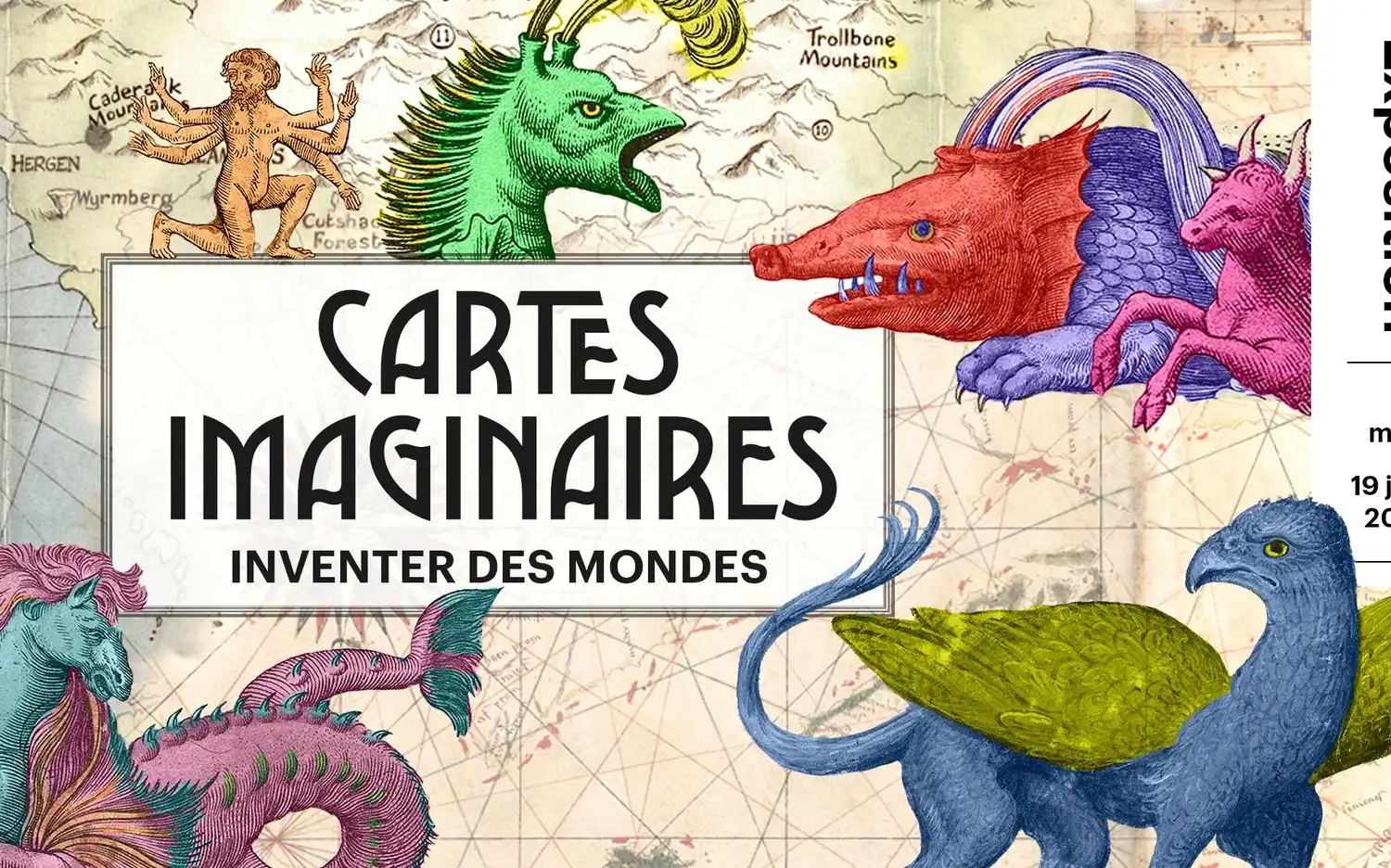
The Cartes Imaginaires: Inventer des Mondes exhibition at the Bibliothèque nationale de France (BnF) François-Mitterrand offers a profound curatorial exploration into the symbiotic relationship between cartography and the human imagination. As a curator, I find this showcase particularly significant for its ability to demonstrate that maps are never merely objective records of geography; they are subjective vessels for our fears, desires, and narrative ambitions. Spanning from medieval manuscripts to the digital landscapes of video games, the exhibition organizes over 200 works into four thematic "stops," guiding the visitor through a sensory and immersive journey where the boundaries of reality and fiction blur.
The historical depth of the collection is remarkable, featuring rare masterpieces that once anchored the unknown. The first sections transport us to a time when cartographers populated the margins of the world with mythical creatures and legendary locales. Significant works on display include Gérard Mercator’s 1595 Atlas, the Cosmographie universelle by Sebastian Münster, and the legendary Royaume du prêtre Jean by Abraham Ortelius. These pieces serve as a testament to the historical significance of myth in early modern science, where the Garden of Eden, Atlantis, and El Dorado were treated with the same geographic seriousness as documented continents, reflecting a deep-seated human need to anchor the marvelous within the physical world.
The transition into the third and fourth sections highlights a shift toward literary and contemporary artistic interpretation. Here, the exhibition bridges the gap between the traditional and the modern, showcasing maps of iconic fictional universes such as Narnia, Middle-earth, and the intricate territories of Game of Thrones, Final Fantasy, and Assassin’s Creed. This dialogue is further enriched by the inclusion of contemporary artists like Brankica Žilović, whose work deconstructs the traditional cartographic device to reveal the subjective construction of our collective vision. By placing an ancient mappamundi alongside a contemporary installation, the curation emphasizes that the act of "mapping" is a continuous process of reinventing our place in the universe.
Ultimately, the emotional resonance of the exhibition lies in its ability to evoke wonder and reverie. Through a dreamlike soundscape and interactive displays, visitors are encouraged to look beyond the lines and grids of coordinates to find the stories hidden within. It reminds us that whether we are navigating a 16th-century sea chart or a digital fantasy world, we are participating in a universal human tradition of inventing new worlds. This exhibition is not just a study of history; it is an invitation to acknowledge that imagining the world is a necessary prerequisite to representing, and ultimately understanding, the reality in which we live.
A masterpiece of modern architecture in Paris, the Bibliothèque nationale de France François-Mitterrand features four iconic glass towers shaped like open books that house millions of rare manuscripts and historic globes, while its minimalist design and lush internal forest garden provide a serene backdrop for world-class cultural exhibitions.
The François-Mitterrand site is closed on public holidays, including January 1st, May 1st, and December 25th.
Exhibitions at this location are always closed on Mondays.
Free entry is available for all visitors to the public reading rooms every day from 5:00 pm to 8:00 pm.
Access to the exhibition spaces is free for visitors under the age of 18.
The library offers free site visits for children under the age of 12.
Located in the 13th arrondissement, the Bibliothèque nationale de France François-Mitterrand is a striking modern landmark overlooking the Seine, easily accessible via an extensive network of public transport.
Complete your cultural itinerary in 2026 with the 58 other top-rated exhibitions in Paris.
Don't miss the 39 iconic cultural landmarks that define Paris in 2026.