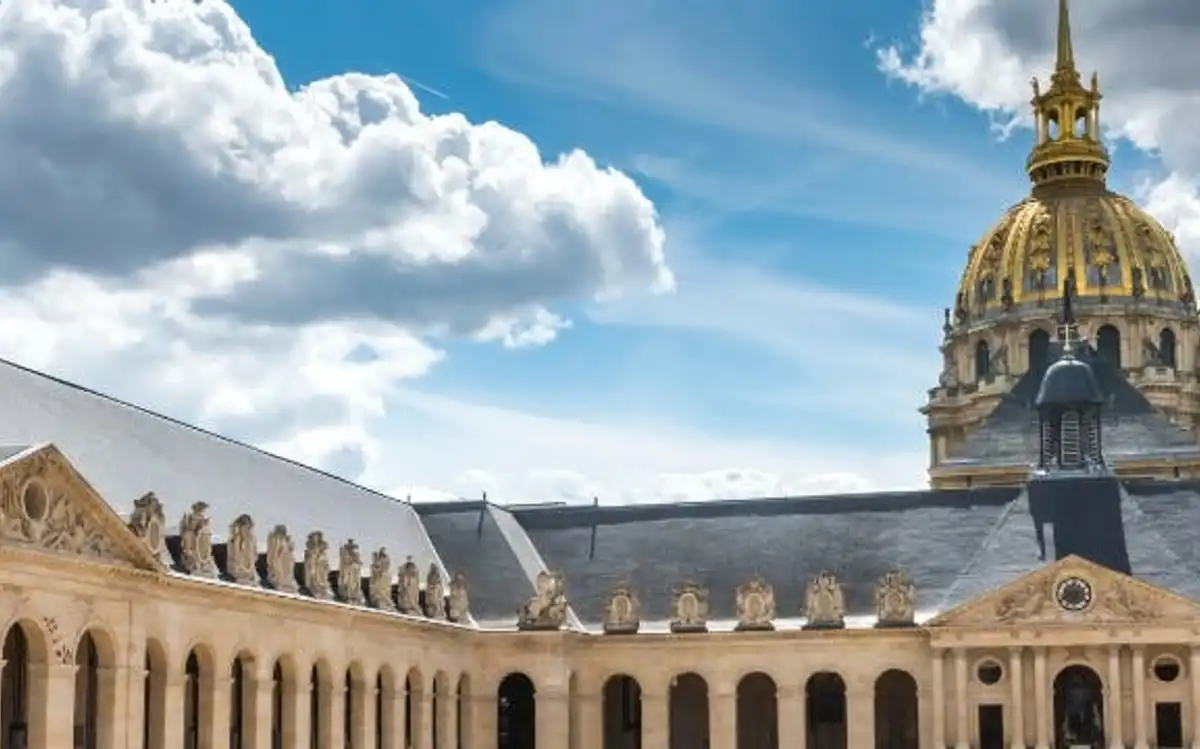
Historic courtyard at Musée de l'Armée with arched windows and a golden-domed building under a partly cloudy sky.

Musée de l'Armée & Napoleon's Tomb

  • Paris

Explore France's storied military history at Paris's Hôtel National des Invalides, where world-class exhibitions showcase prestigious armor and weapons alongside the monumental gilded tomb of Napoleon Bonaparte. This cultural landmark in the 7th arrondissement offers a profound journey through centuries of heritage, from medieval combat to the legacies of the French Empire.

Historical artifacts and scientific instruments displayed in a gallery at the Explorations exhibition.

Explorations: A Matter of State?

  • Musée de l'Armée & Napoleon's Tomb, Paris
15 Apr - 16 Aug 2026
From€17.00

An elegant interrogation of sovereign power and the evolving nature of the state.

Housed within the monumental Hôtel National des Invalides, the Musée de l'Armée stands as a profound testament to France's martial legacy and architectural grandeur. Originally commissioned by Louis XIV in 1670 as a hospital and retirement home for veteran soldiers, this sprawling complex in the 7th arrondissement has evolved into one of the world’s premier military history institutions. Visitors are immediately struck by the site's scale, from the expansive Esplanade des Invalides to the rhythmic symmetry of the Cour d'Honneur, where a formidable collection of artillery pieces charts two centuries of French history.

The museum’s interior offers an exhaustive journey through time, featuring over 500,000 artifacts that span from the Bronze Age to the modern era. The Old Armor and Weapons department is a particular highlight, boasting a world-class collection of medieval suits of armor, Renaissance swords, and ceremonial royal equipment. As you move through the Modern Department, the narrative shifts to the Napoleonic era and the World Wars, showcasing evocative personal items like Napoleon Bonaparte’s bicorn hat and the Marne Taxi, which transported soldiers to the front in 1914. The atmosphere is one of solemnity and discovery, as interactive displays and meticulously restored uniforms bring the human element of global conflict to life.

The undeniable crown jewel of the complex is the Dôme des Invalides, a masterpiece of French Baroque architecture designed by Jules Hardouin-Mansart. Once the royal chapel, its shimmering Golden Dome serves as a beacon on the Paris skyline, rising 107 meters high. Beneath this celestial vault, the atmosphere transitions into one of quiet reverence within the crypt. Here, the monumental Tomb of Napoleon I rests—a massive sarcophagus of red quartzite placed upon a green granite base. Surrounded by twelve Victory statues and laurel-wreathed mosaics, the Emperor’s final resting place is a breathtaking fusion of art and national pride.

Beyond the imperial tomb, the site remains a living monument, housing the Cathedral of Saint-Louis-des-Invalides and the Historial Charles de Gaulle. The experience of visiting is multifaceted; it is at once a deep dive into the technological evolution of warfare, a walk through a former royal residence, and a moment of reflection on the figures who shaped the modern world. Whether admiring the intricate frescoes of the Dome or exploring the Museum of Military Models, visitors are immersed in a narrative that defines the very soul of French history.

Highlights

  • The monumental red quartzite Sarcophagus of Napoleon Bonaparte lies directly beneath the majestic golden dome in a sunken circular crypt.
  • The Dôme des Invalides features a stunning 107-meter-high gilded cupola that is a prominent landmark of the Paris skyline.
  • The Cour d'Honneur is a grand historic courtyard displaying ornate architecture, arched windows, and classical French Baroque design.
  • The Armory Collections showcase one of the world's most extensive displays of medieval armor, royal weapons, and knightly equipment.
  • The Church of Saint-Louis des Invalides served as the temporary resting place for Napoleon's remains for twenty years before his final tomb was finished.
  • The Historial Charles de Gaulle offers an immersive multimedia experience exploring the life and military impact of the famous French general.

Must-Dos

  • Look up to admire the celestial frescoes painted by Charles de La Fosse on the interior of the dome's high vault.
  • Walk through the World War II wings to see artifacts from Free France and the Internal Resistance, including the iconic Marne Taxi.
  • Visit the museum on Wednesday or Friday afternoons after 3pm to enjoy a quieter atmosphere away from large school groups.
  • Explore the Musée des Plans-Reliefs to examine over 100 detailed three-dimensional models of historic fortified French cities.
  • Pause in the former refectory to view the original 17th-century murals celebrating the early conquests of Louis XIV.
  • Search for the hidden tombs of other French military figures like Marshal Foch and Joseph Bonaparte located in the side chapels of the Dome church.
  • Cross the Pont Alexandre III for the most dramatic approach and symmetrical view of the golden-domed landmark.

Guidelines

  • All visitors must pass through a security check at the entrance of the Hôtel National des Invalides.
  • Large bags and luggage exceeding the maximum permitted dimensions are strictly prohibited inside the museum.
  • Visitors are required to maintain a safe distance and must not touch the artworks, monuments, or historical artifacts.
  • Photography and filming for personal use are permitted in most areas provided that you do not use a flash.
  • The use of tripods, monopods, or selfie sticks is forbidden inside the galleries and the Dome.
  • Smoking, including the use of e-cigarettes and vapes, is not allowed anywhere within the museum buildings.
  • Eating and drinking are strictly prohibited in the exhibition rooms and near the tomb of Napoleon.

Tips

  • Visit the museum on Wednesday or Friday late afternoons after 3pm to avoid school groups and enjoy shorter wait times for the exhibits.
  • Enter via the Place Vauban side between 2pm and 6pm for a more direct route to the golden dome and Napoleon's Tomb.
  • Take advantage of the late-night opening until 10pm on the first Friday of each month to experience the monuments with significantly fewer crowds.
  • Seek out the Relief Map Museum tucked away in the attic spaces for a fascinating and often completely empty gallery experience.
  • Start your tour at the modern Historial Charles de Gaulle wing and move counterclockwise to build a better historical context while avoiding the typical visitor congestion.
  • Wear comfortable shoes as exploring the entire historic complex and its various museum wings typically requires at least 3 to 4 hours of walking.

Why Visit

While the Eiffel Tower defines the skyline, the Musée de l'Armée defines the spirit of France. This is not merely a collection of artifacts; it is a visceral encounter with the legends who forged a nation. From the glittering steel of medieval knights to the personal effects of the Emperor himself, the scale of this institution is unmatched. Stepping onto the grounds, you feel the weight of centuries, making it an essential pilgrimage for anyone seeking to understand the grandeur and resilience of the French identity.

Standing beneath the celestial frescoes of the great Dome, the atmosphere shifts from historical curiosity to profound awe. The air feels still as you look down into the crypt at the monumental red quartzite sarcophagus of Napoleon, a sight that commands a unique, hushed respect. Whether you are mesmerized by the intricate light filtering through stained glass or the haunting silence of the side chapels, the experience is a sensory journey that connects you to the living memory of Europe’s most pivotal moments.To visit this site is to stand at the intersection of architectural brilliance and imperial legacy, where the echoes of history are written in gold and stone.

When to Visit

Late-Day Gallery Sequencing

Arriving on Wednesday or Friday after 3:00 PM significantly reduces interactions with large school groups and tour buses. Most visitors saturate the halls between 11:00 AM and 2:00 PM, so deferring entry until the final three hours of operation ensures a quieter path through the armor collections.

Dôme Fresco Clarity

Natural light filters most effectively through the high windows of the Dôme des Invalides during the early morning shortly after the 10:00 AM opening, providing the best visibility for the overhead artwork. If you prefer the dramatic interplay of shadows against the red quartzite sarcophagus, aim for the hour before the 5:30 PM last entry. Monthly opportunities also exist on the first Friday when the complex reopens from 6:00 PM to 10:00 PM, allowing the architectural details to be viewed under evening spotlighting.

How to Visit

Navigating the sprawling complex of Les Invalides requires a bit of foresight to truly enjoy the evolution of French history without getting lost in the sheer volume of the collections. To do this properly, you should budget at least 2.5 to 3 hours. While many tourists flock to the northern Esplanade, the savvy move is to use the south entrance at Place Vauban. This entry drops you right at the doorstep of the Dôme des Invalides, allowing you to experience the most iconic part of the site immediately before diving into the military galleries.

Mapping Your Imperial March

To keep your energy high and your route logical, I recommend a "back-to-front" approach that prioritizes the heavy hitters first.

  • Start at the Dôme des Invalides to pay your respects at the Sarcophagus of Napoleon Bonaparte and admire the architectural heights of the church.
  • Walk through the corridor to the Cour d'Honneur, the massive central courtyard where you can see the classical artillery collection lined up in the open air.
  • Head into the Old Armor and Arms department on the West side; it's one of the most extensive collections of medieval and Renaissance weaponry in the world.
  • Finish with the Modern Department, which covers the World Wars, located on the upper floors of the East wing, providing a sobering transition into the 20th century.

Logistics for a Smooth Visit

Security is tight at both the Esplanade des Invalides and Place Vauban gates, so travel light to speed through the mandatory bag checks. If you are arriving via the Metro, Line 8 (La Tour-Maubourg) or Line 13 (Saint-François-Xavier) are your best bets for a short walk to the gates. Keep in mind that while the museum is vast, there are no lockers for large suitcases, so ensure your luggage stays at your hotel. For a mid-visit break, the Café Carré in the center of the complex offers a quiet spot to regroup before tackling the final galleries.

Schedules

Opening Hours

  • The Musée de l'Armée and Napoleon's Tomb are open daily from 10:00 AM to 6:00 PM.
  • The last entry to the museum complex is permitted until 5:30 PM, which is 30 minutes before closing.
  • On the first Friday of each month, the venue offers late-night openings from 6:00 PM until 10:00 PM.
  • The ticket office for these evening sessions closes at 9:00 PM.

Special Days

The museum is closed annually on January 1, May 1, and December 25.

On the first Friday of each month, the venue offers late-night openings from 6 p.m. to 10 p.m.

Visitors can enjoy free admission to the entire museum on July 14 in celebration of Bastille Day.

How to get there

Located in the heart of the 7th arrondissement, the Musée de l'Armée and Napoleon's Tomb sit within the grand Hôtel National des Invalides, a short and scenic walk from the banks of the Seine. This historic complex is exceptionally well-connected, offering visitors a variety of seamless public transport links from across the city.

  • Metro: Line 8 to La Tour-Maubourg or Invalides, and Line 13 to Varenne or Invalides.
  • RER: Line C to the Invalides station.
  • Bus: Lines 28, 63, 69, 82, 83, 87, 92, and 93 all serve stops near the venue, such as Invalides, La Tour-Maubourg, or Vauban – Hôtel des Invalides.
Directions

Frequently Asked Questions about Musée de l'Armée & Napoleon's Tomb

Free self-service lockers are available at the entrance of the military history museum for small personal items. However, for security reasons at the Hôtel National des Invalides, large suitcases and bulky luggage exceeding 55cm x 35cm x 20cm are strictly prohibited and cannot be stored on-site.
Yes, the Dôme des Invalides and the crypt housing the Tomb of Napoleon Bonaparte are equipped with ramps and elevators for accessibility. While most areas of the museum are accessible, some sections of the historic armor collection may require assistance due to the building's ancient architectural layout.
The most iconic shots can be captured from the Esplanade des Invalides facing the Golden Dome, or within the Cour d'Honneur featuring the rows of classic artillery. Inside, the celestial frescoes of the Dôme des Invalides and the symmetrical view of Napoleon's red quartzite sarcophagus from the upper gallery provide stunning perspectives.
A general admission ticket to the Musée de l'Armée typically includes access to the permanent collections, the Dôme des Invalides, and any current temporary military art exhibitions. This provides a comprehensive look at everything from the French armor collection to modern 'Paris war museum' displays.
The 'Le Carré des Invalides' café-restaurant, located near the main entrance, offers meals and snacks for visitors. While picnicking is not allowed inside the museum or the courtyard, the expansive lawns of the Esplanade des Invalides just outside the gates are a popular spot for a relaxed outdoor break.
The museum is conveniently located near several Metro stations. The most direct access points are 'La Tour-Maubourg' or 'Invalides' on Line 8, and 'Varenne' or 'Saint-François-Xavier' on Line 13. The RER C station 'Invalides' also provides a short walk to the main entrance.
Personal photography without flash is permitted throughout most of the site, including the area surrounding Napoleon's Tomb. However, the use of tripods and professional lighting equipment is prohibited to ensure a respectful atmosphere and a steady flow of visitors within the sacred space of the royal chapel.
To see the major highlights, including the French armor collection and the Dôme des Invalides, you should allocate at least 2.5 to 3 hours. If you wish to explore the World War galleries and the Historial Charles de Gaulle in detail, a half-day visit is recommended to fully appreciate this vast military history museum.
While there is no formal dress code for the Musée de l'Armée, visitors are expected to maintain a respectful demeanor as the Dôme des Invalides is a place of national commemoration. Comfortable walking shoes are highly recommended due to the cobblestone courtyards and the extensive size of the Hôtel National des Invalides complex.
Recommended
Vibrant satirical photography by Martin Parr exploring global tourism and consumerism at the Jeu de Paume gallery.
Stark black-and-white landscape photography captures the silent aftermath of South African conflict and memory.
Recommended
Mummified human remains and funerary objects in a modern, respectfully lit gallery at the Musee de l'Homme.
Vibrant street performers and colorful Holi festival celebrations at the historic Jardin d'Acclimatation in Paris.
Crowd at Jardin d'Acclimatation celebrating Holi with a vibrant explosion of colorful powders in the Parisian sky.
Archaeological artifacts from the Seine riverbed displayed in the underground crypt beneath Notre-Dame cathedral.
Sculptures of 20th-century conflict in the modernist Ateliers-musee Chana Orloff gallery in Paris.
Recommended
Digital art projections of Da Vinci and Michelangelo masterpieces illuminate a large immersive gallery space.
A selection of delicate pencil and pastel sketches by Pierre-Auguste Renoir displayed in a gallery.
Antique Korean beauty accessories and traditional paintings displayed in a modern museum gallery at Musée Guimet.
Vibrant interactive garden chapter at Cité des sciences featuring lush plants and sensory science displays.
Recommended
Elegant 18th-century gowns and contemporary couture on display in a grand gallery at Palais Galliera.
Recommended
Visitors walk among sculptures in the vaulted glass hall of Musée d'Orsay, with others seated on benches.
4 exhibitions

Musée d'Orsay

  • Paris

Breathtaking Impressionist masterpieces housed within the timeless elegance of a magnificent Parisian station.

Recommended
Modern curved glass and metal Fondation Louis Vuitton building under a blue sky with trees and parked cars.
1 exhibition

Fondation Louis Vuitton

  • Paris

Where avant-garde art meets Frank Gehry’s breathtaking glass sails in the heart of Paris.

Recommended
Grand mansion at Musée Rodin viewed through manicured gardens with a central pond, statues, and trimmed bushes.
1 exhibition

Musée Rodin Paris

  • Paris

A historic mansion sanctuary where Rodin’s emotive masterpieces breathe amidst rose-filled gardens.

Recommended
Ornate stone Musée de l'Orangerie entrance with large columns and one person standing near the doorway.
2 exhibitions

Musée de l'Orangerie

  • Paris

A luminous sanctuary where Monets panoramic Water Lilies bloom in timeless Impressionist light.

Recommended
Grand neoclassical Palais Garnier with golden statues and a French flag under a blue sky.
1 exhibition

Palais Garnier

  • Paris

A breathtaking masterpiece of nineteenth-century opulence and legendary Parisian high culture.

Recommended
Vibrant abstract projections from the Kandinsky exhibition at the Atelier des Lumières digital art center.
1 exhibition

Atelier des Lumières

  • Paris

Masterpieces come alive through immersive light and sound in a historic Parisian foundry.

Recommended
Intricate metal framework of a large glass dome casting shadows on a mural of historical and mythical scenes.
1 exhibition

Bourse de Commerce - Pinault Collection

  • Paris

A sanctuary of contemporary masterpieces housed within a masterfully restored historic dome.

Neoclassical building with tall columns, large windows, outdoor seating, and a statue holding a spear.
2 exhibitions

Musée d'Art Moderne de Paris

  • Paris

A sanctuary of avant-garde masterpieces and evolving contemporary narratives in the heart of Paris.

Grand building with arched windows, statues, and a central fountain, surrounded by lawns and city buildings.
2 exhibitions

Palais Galliera

  • Paris

A grand Renaissance palace enshrining the timeless evolution of French fashion and contemporary artistry.

Exhibit wall with multilingual text about Georges Méliès, surrounded by framed portraits and illustrations.
1 exhibition

La Cinémathèque Française

  • Paris

A stunning Frank Gehry masterpiece housing the world's most prestigious collection of cinematic treasures.

Elegant stone mansion with arched doorways and a columned entrance, set within a manicured courtyard.
1 exhibition

Musée Jacquemart-André

  • Paris

An opulent Haussmann-era mansion housing one of the city's most prestigious private art collections.

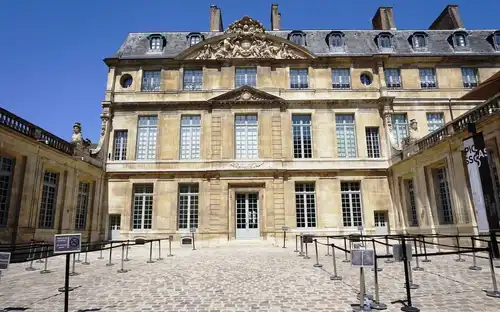
Stone Musée National Picasso-Paris with ornate sculptures and large windows under a clear sky from a courtyard.
3 exhibitions

Musée national Picasso-Paris

  • Paris

The profound legacy of the twentieth century’s most iconic artist in the historic Marais.