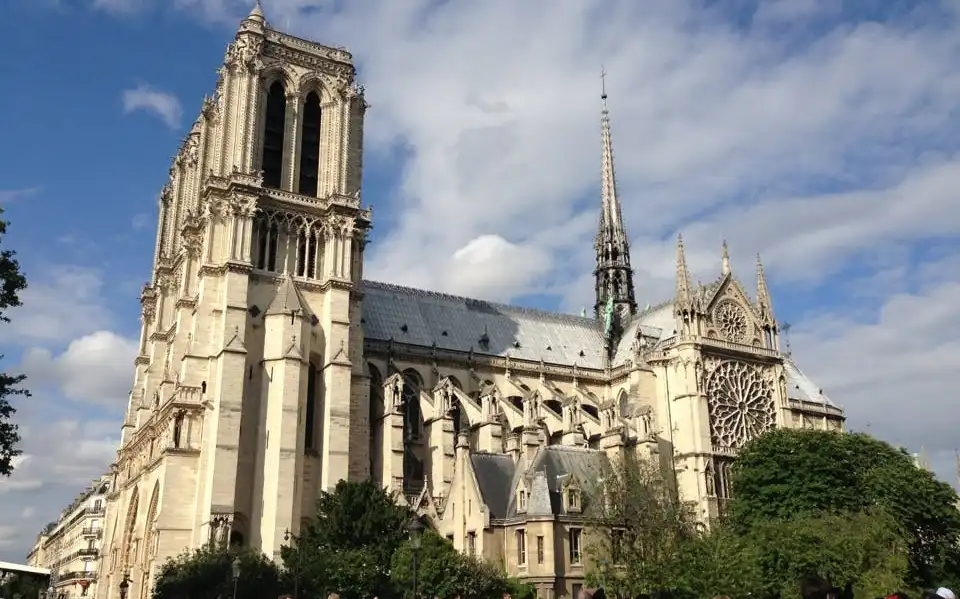
Crowd in front of the Notre-Dame Cathedral in Paris under a partly cloudy sky with visible towers and spire.
Recommended

Notre-Dame Cathedral of Paris

  • Paris

Marvel at the intricate Gothic architecture and legendary stained glass windows of this Parisian icon, home to world-class historical exhibitions. Ascend the famous bell towers for an unparalleled panoramic view over the heart of Paris.

An unparalleled symbol of the French capital, Notre-Dame de Paris embodies nearly nine centuries of history, religious art, and architectural prowess. A true masterpiece of the Gothic style, this celebrated Catholic cathedral stands as a testament to faith on the Île de la Cité, an island in the Seine River. Construction began in 1163 under Bishop Maurice de Sully and spanned nearly two centuries, reflecting the progression from Romanesque to Gothic architecture. Over the years, it has served as the stage for monumental historical events, including the coronation of Napoleon Bonaparte and the beatification of Joan of Arc, cementing its status as a universal monument of French national identity.

The cathedral's architecture is world-renowned for its pioneering innovations, most notably the use of flying buttresses. These arched structures enabled the construction of soaring walls and the installation of immense, colorful rose windows, which remain masterpieces of medieval craftsmanship. Visitors are drawn to the imposing western façade, home to two majestic towers standing 69 meters tall, and the famous gallery of chimeras. Inside, the ribbed vaulting and detailed stone carvings create a sense of weightless grandeur. The cathedral also houses invaluable religious relics, such as the Crown of Thorns, and features a legendary grand organ with nearly 8,000 pipes.

Stepping into Notre-Dame offers a profound atmosphere where the spiritual meets the historic. The interior is bathed in a ethereal, color-filled light filtered through centuries-old stained glass, designed to symbolize the presence of the divine. Despite the devastating fire of 2019, which destroyed the 19th-century spire designed by Viollet-le-Duc, a monumental restoration project has led to the cathedral's triumphant rebirth. Today, visitors can once again experience the awe-inspiring scale of the nave and the intricate beauty of the choir, feeling the enduring spirit of a monument that has survived revolutions, wars, and time itself.

Highlights

  • The Western Facade features three ornate portals, including the Portal of the Last Judgment, decorated with intricate stone carvings.
  • The Rose Windows are 13th-century masterpieces of Gothic stained glass that bathe the cathedral in a kaleidoscope of light.
  • The Gargoyles and Chimeras perched atop the towers were added during the 19th-century restoration to serve as both rain spouts and gothic guardians.
  • The Flying Buttresses are pioneering structural elements that allow the building to reach its soaring height while maintaining a graceful silhouette.
  • The Great Organ is one of the world's most famous instruments, featuring nearly 8,000 pipes and components dating back to the 15th century.
  • The Statue of Our Lady is a revered 14th-century sculpture of the Virgin and Child located by the southeast pillar.
  • The Cathedral Treasury houses sacred relics such as the Crown of Thorns and rare liturgical objects from centuries of French history.

Must-Dos

  • Descend into the Crypte Archéologique beneath the cathedral's plaza to explore 2,000-year-old Roman ruins and the ancient remains of Lutetia.
  • Find a bench in Square Jean XXIII behind the cathedral to enjoy a quiet moment surrounded by Japanese cherry blossoms and romantic views of the Seine.
  • Stroll across the Pont de l'Archevêché at sunrise to capture the cathedral's silhouette illuminated by the soft morning light.
  • Listen for the deep resonance of Emmanuel, the 15th-century tenor bell, which rings out from the south tower during major historical commemorations.
  • Climb the spiral stone staircase of the towers to witness a 360-degree panoramic view of the Parisian skyline and the river winding below.
  • Walk a few minutes west to Pont Neuf to admire the stone mascarons and watch sightseeing boats glide past the Île de la Cité.

Guidelines

  • All visitors must undergo security screenings and identity checks before entering the cathedral, treasury, or towers.
  • Only small bags and rucksacks up to a maximum size of 40x35x15cm are permitted inside the venue.
  • Large items of luggage, including wheeled suitcases and hiking rucksacks, are strictly prohibited and cannot be stored on-site.
  • Visitors must maintain a respectful atmosphere by avoiding loud talking and ensuring cell phones are set to silent mode.
  • Appropriate clothing that covers shoulders and knees is required to enter this sacred place of worship.
  • The consumption of food and drinks is not allowed inside the cathedral and must take place outdoors.
  • Photography without flash is generally permitted for private use, but the use of tripods and drones is strictly forbidden.

Tips

  • Arrive during the early morning between 7:45 AM and 9:00 AM to enjoy the most peaceful atmosphere and avoid the heavy midday tourist crowds.
  • Secure a free online reservation in advance through the official platform to bypass lines that can often stretch for two to three hours during peak times.
  • Visit on Tuesday or Wednesday mornings for the best availability of time slots and a generally calmer experience inside the cathedral.
  • Head to the Tower entrance located on the left side of the west facade if you wish to climb the staircase for panoramic views and a close-up look at the famous gargoyles.
  • Consider visiting on Thursday evenings when the cathedral offers extended hours until 10:00 PM, providing a rare opportunity to see the interior under evening light.
  • Use the west entrance if you are attending a Catholic Mass, as worshippers typically have a designated line with a much shorter wait time than the general tourist queue.
  • Dress modestly with shoulders and knees covered to show respect for the site's status as an active place of worship and ensure a smooth entry through security.

Why Visit

Standing at the very epicenter of Paris, the Notre-Dame Cathedral is more than a monument; it is the pulsing heart of French soul and resilience. To visit now is to witness a modern miracle, where the extraordinary dedication of master artisans has breathed life back into stone and glass following the 2019 fire. Beyond the architectural prestige, it offers a rare opportunity to see a global icon in its most triumphant era, a moment where centuries of tradition meet a spectacular rebirth that has captivated the world.

The moment you cross the threshold, the world outside vanishes, replaced by a celestial glow reflecting off recently cleaned limestone that seems to radiate its own light. The air carries a faint, lingering scent of sacred incense and ancient timber, while the sheer verticality of the nave pulls your gaze upward in an instinctive act of wonder. To hear the reawakened grand organ or the deep, rhythmic tolling of the bells is to feel a physical vibration of history, a sensory immersion that connects you to the millions of pilgrims and dreamers who have sought solace beneath these soaring Gothic arches.Notre-Dame stands as a timeless portal where the raw power of human craftsmanship and the enduring strength of the spirit unite to create the most profound emotional experience in the City of Light.

When to Visit

Early Morning Entry for Serenity

Stepping through the portals between 7:50 AM and 9:00 AM on Monday to Wednesday is the most effective way to outpace the heavy tourist traffic that typically builds by mid-morning. During these initial opening hours, the interior remains remarkably quiet, allowing for a clear view of the nave and the intricate Gothic details without the obstruction of large tour groups. Security screenings and identity checks move much faster during this window, ensuring that your transition from the plaza to the interior is as seamless as possible before the midday rush peaks.

Rose Window Illumination and Shadow Play

Photographers and architecture enthusiasts should prioritize the late afternoon to witness the most dramatic interplay of light across the western facade and the famous rose windows. As the sun begins its descent, the shifting angles create a symphony of shadows that accentuate the stone carvings and the three ornate portals, including the Portal of the Last Judgment. Planning your stay until the cathedral closes at 7:00 PM on most days—or even 10:00 PM on Thursdays and Saturdays—provides a unique opportunity to see the transition from natural sunlight to the atmospheric artificial lighting that highlights the spire and towers against the Paris skyline.

How to Visit

To navigate the crowd and security at this Parisian landmark, you should budget at least two hours for a complete experience. Most of your time will be spent on the exterior and the main floor, but if you intend to descend into the history of the city, add an extra hour for the subterranean levels.

Navigating the Western Front

Before you even step inside, spend time at the Western Facade. This is where the story begins. You will enter through the lower part of the facade, typically directed toward the central portals. Pay close attention to the Portal of the Last Judgment; it is the most detailed of the three and serves as a masterclass in medieval storytelling through stone.

  • Start at the Western Facade to identify the three distinct portals and the Gallery of Kings.
  • Follow the path into the Nave, moving slowly toward the High Altar to appreciate the scale of the stone columns and vaulted ceilings.
  • Circle around the Ambulatory to view the radiating chapels, each offering a unique historical perspective.
  • Finish by heading back outside to the plaza to find the entrance for the Crypte Archéologique, located just beneath the cathedral's feet.

Below the Parvis

Many visitors miss the world waiting beneath the plaza. The Crypte Archéologique contains ruins that date back two millennia, offering a silent contrast to the towering Gothic arches above. It is a separate entrance but an essential one for anyone wanting to understand the very foundations of Paris. For those looking for the ultimate view, look for the specific queue for the Towers, which requires a separate fee and a climb of 387 steps to see the famous gargoyles up close.

Schedules

Opening Hours

  • The cathedral is open Monday to Wednesday and Friday from 7:50 AM to 7:00 PM.
  • On Thursday, visitors can explore the venue during extended hours from 7:50 AM to 10:00 PM.
  • Saturday and Sunday hours are slightly different, with doors open from 8:15 AM to 7:30 PM.
  • For all visiting days, the last entry is permitted until 30 minutes before the scheduled closing time.

Special Days

The cathedral remains closed on January 1st, May 1st, and December 25th each year.

Admission to the cathedral is free of charge for all visitors every day during its regular opening hours.

The venue participates in special events like the Night of the Cathedrals on April 26th with unique access.

How to get there

Located in the historic 4th arrondissement on the Île de la Cité, the Notre-Dame Cathedral of Paris stands as a majestic sentinel at the very heart of the city, perfectly situated along the banks of the Seine. This iconic landmark is exceptionally accessible via a variety of central public transport hubs, making it an effortless destination for any Parisian itinerary.

  • Metro: Line 4 to Cité or Saint-Michel; additionally, Lines 1, 7, 11, and 14 serve the nearby Châtelet station.
  • RER: Lines B and C to the Saint-Michel Notre-Dame station, which offers direct access to the cathedral's plaza.
  • Bus: Lines 21, 27, 38, 47, 75, 87, and 96 all stop at stations in the immediate vicinity, including Cité - Palais de Justice and Saint-Michel - Notre-Dame.
  • Batobus: The Notre-Dame stop on the Quai de Montebello provides a scenic riverside arrival by boat.
Directions

Frequently Asked Questions about Notre-Dame Cathedral of Paris

For safety and security reasons, there are no cloakrooms or luggage storage facilities within the Notre-Dame Cathedral of Paris. Visitors are advised not to bring large bags or suitcases, as items exceeding standard carry-on dimensions are not permitted inside this UNESCO World Heritage site.
The climb to the majestic towers involves a narrow, winding staircase of nearly 400 steps with no elevator access, making it inaccessible for strollers. While pushchairs may be used in the main nave area, they must often be folded or left in designated areas during peak times to preserve the flow of movement through the Gothic architecture.
To capture the intricate flying buttresses and the South Rose Window, head to the Square Jean XXIII located at the rear of the cathedral. For a classic shot of the western façade and its two towers, the 'Parvis de Notre-Dame' on the Île de la Cité provides the perfect wide-angle perspective of this masterpiece of French history.
The Crypte Archéologique de l'Île de la Cité, located right beneath the cathedral square, frequently hosts Paris exhibitions that reveal ancient Roman ruins and medieval foundations. These exhibitions offer a deeper look into the layers of French history that predate the cathedral's construction in 1163.
Entry to the main nave of the Notre-Dame Cathedral of Paris for individual prayer and sightseeing is traditionally free. However, specific areas like the Treasury, which houses precious religious art and relics like the 'Crown of Thorns', or the climb to the towers require a paid ticket or a Paris Museum Pass.
To see the North Rose Window illuminated in all its glory, a morning visit is recommended. Conversely, the afternoon sun beautifully highlights the South Rose Window, casting vibrant colors of religious art across the stone interior, creating an ethereal atmosphere within the cathedral walls.
Photography for personal use is permitted inside the cathedral; however, the use of flash and tripods is strictly prohibited to protect the delicate stained glass windows and maintain a respectful environment for worship. This ensures the preservation of the Gothic architecture for future generations.
Mass is held daily and is open to the public, offering a unique way to experience the cathedral's spiritual purpose. To hear the legendary grand organ, visitors should check the schedule for special recitals or high-mass services where the instrument's 8,000 pipes bring the history of Paris to life through music.
The main floor of the cathedral, including the nave and choir, is accessible to visitors in wheelchairs via ramps at the side entrance. Due to the historic nature of the building, the upper towers and the gallery of chimeras remain accessible only by foot via steep spiral stairs.
Recommended
Vibrant satirical photography by Martin Parr exploring global tourism and consumerism at the Jeu de Paume gallery.
Stark black-and-white landscape photography captures the silent aftermath of South African conflict and memory.
Recommended
Mummified human remains and funerary objects in a modern, respectfully lit gallery at the Musee de l'Homme.
Vibrant street performers and colorful Holi festival celebrations at the historic Jardin d'Acclimatation in Paris.
Crowd at Jardin d'Acclimatation celebrating Holi with a vibrant explosion of colorful powders in the Parisian sky.
Archaeological artifacts from the Seine riverbed displayed in the underground crypt beneath Notre-Dame cathedral.
Sculptures of 20th-century conflict in the modernist Ateliers-musee Chana Orloff gallery in Paris.
Recommended
Digital art projections of Da Vinci and Michelangelo masterpieces illuminate a large immersive gallery space.
A selection of delicate pencil and pastel sketches by Pierre-Auguste Renoir displayed in a gallery.
Antique Korean beauty accessories and traditional paintings displayed in a modern museum gallery at Musée Guimet.
Vibrant interactive garden chapter at Cité des sciences featuring lush plants and sensory science displays.
Recommended
Elegant 18th-century gowns and contemporary couture on display in a grand gallery at Palais Galliera.
Recommended
Visitors walk among sculptures in the vaulted glass hall of Musée d'Orsay, with others seated on benches.
4 exhibitions

Musée d'Orsay

  • Paris

Breathtaking Impressionist masterpieces housed within the timeless elegance of a magnificent Parisian station.

Recommended
Modern curved glass and metal Fondation Louis Vuitton building under a blue sky with trees and parked cars.
1 exhibition

Fondation Louis Vuitton

  • Paris

Where avant-garde art meets Frank Gehry’s breathtaking glass sails in the heart of Paris.

Recommended
Grand mansion at Musée Rodin viewed through manicured gardens with a central pond, statues, and trimmed bushes.
1 exhibition

Musée Rodin Paris

  • Paris

A historic mansion sanctuary where Rodin’s emotive masterpieces breathe amidst rose-filled gardens.

Recommended
Ornate stone Musée de l'Orangerie entrance with large columns and one person standing near the doorway.
2 exhibitions

Musée de l'Orangerie

  • Paris

A luminous sanctuary where Monets panoramic Water Lilies bloom in timeless Impressionist light.

Recommended
Grand neoclassical Palais Garnier with golden statues and a French flag under a blue sky.
1 exhibition

Palais Garnier

  • Paris

A breathtaking masterpiece of nineteenth-century opulence and legendary Parisian high culture.

Recommended
Vibrant abstract projections from the Kandinsky exhibition at the Atelier des Lumières digital art center.
1 exhibition

Atelier des Lumières

  • Paris

Masterpieces come alive through immersive light and sound in a historic Parisian foundry.

Recommended
Intricate metal framework of a large glass dome casting shadows on a mural of historical and mythical scenes.
1 exhibition

Bourse de Commerce - Pinault Collection

  • Paris

A sanctuary of contemporary masterpieces housed within a masterfully restored historic dome.

Neoclassical building with tall columns, large windows, outdoor seating, and a statue holding a spear.
2 exhibitions

Musée d'Art Moderne de Paris

  • Paris

A sanctuary of avant-garde masterpieces and evolving contemporary narratives in the heart of Paris.

Historic courtyard at Musée de l'Armée with arched windows and a golden-domed building under a partly cloudy sky.
1 exhibition

Musée de l'Armée & Napoleon's Tomb

  • Paris

France's storied military legacy rests beneath a majestic golden dome of timeless architectural grandeur.

Grand building with arched windows, statues, and a central fountain, surrounded by lawns and city buildings.
2 exhibitions

Palais Galliera

  • Paris

A grand Renaissance palace enshrining the timeless evolution of French fashion and contemporary artistry.

Exhibit wall with multilingual text about Georges Méliès, surrounded by framed portraits and illustrations.
1 exhibition

La Cinémathèque Française

  • Paris

A stunning Frank Gehry masterpiece housing the world's most prestigious collection of cinematic treasures.

Elegant stone mansion with arched doorways and a columned entrance, set within a manicured courtyard.
1 exhibition

Musée Jacquemart-André

  • Paris

An opulent Haussmann-era mansion housing one of the city's most prestigious private art collections.