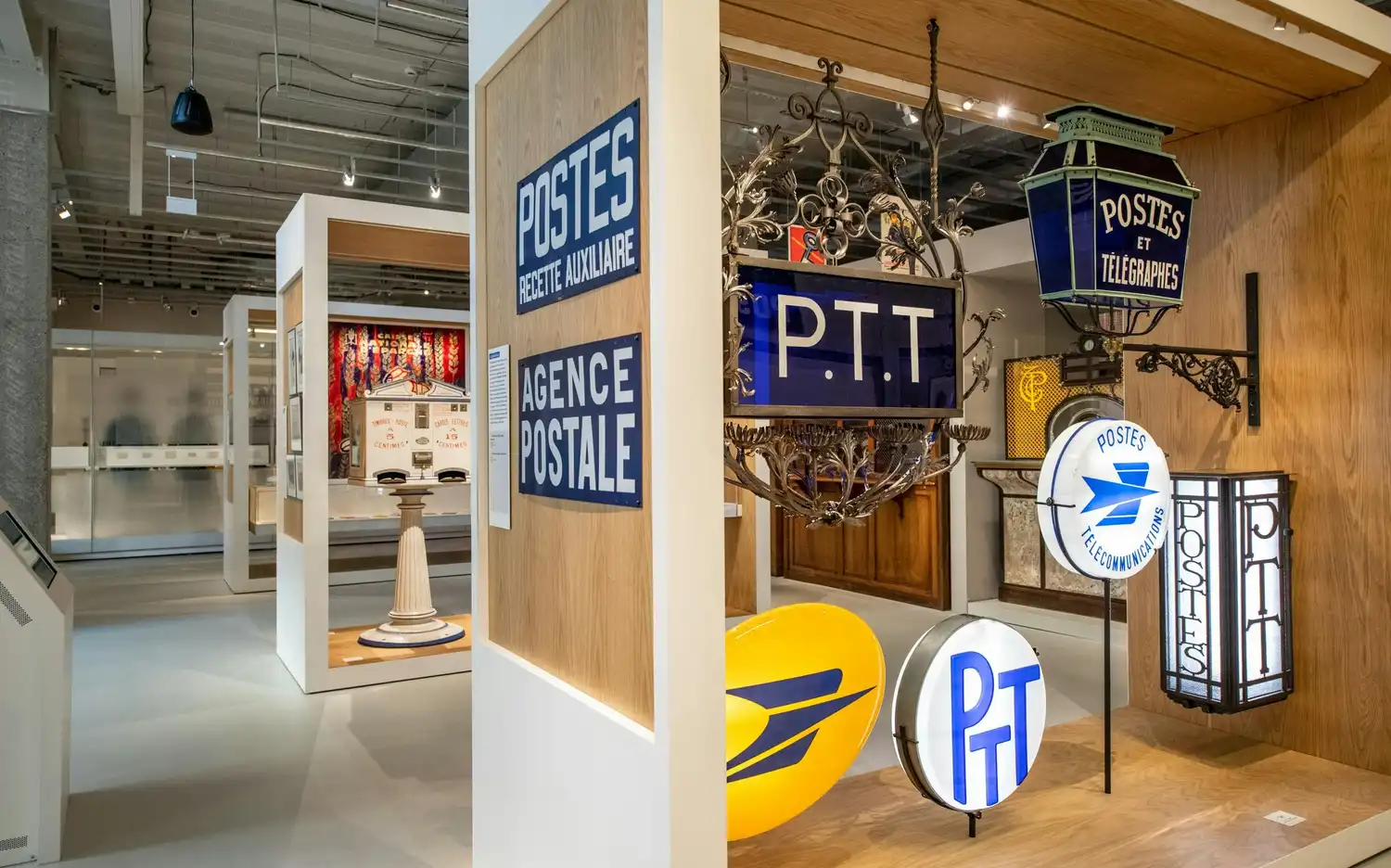
Permanent exhibition of historic shop signs on the third floor of the Musée de la Poste.

Musée de la Poste

  • Paris

Nestled in the heart of Montparnasse, the Musée de la Poste offers a captivating journey through French history via extensive philatelic collections and contemporary art exhibitions. This unique Paris museum chronicles the evolution of communication, from ancient messengers to modern innovations, across three floors of fascinating historical artifacts.

Nestled in the heart of the vibrant Montparnasse district, the Musée de la Poste offers a captivating journey through six centuries of French history seen through the lens of communication. Reopened in 2019 after an extensive four-year renovation by the Jung Architecture studio, the museum is housed in a distinctive 1970s building that has been transformed into a luminous, contemporary space. The architectural centerpiece is a spectacular Totem—a 20-meter-high glass and metal column that pierces through the center of the building, bathing the interior in natural light and serving as a vertical guide for visitors as they explore the permanent collections spread across three levels.

The museum’s significance lies in its ability to mirror the evolution of French society. Visitors begin their journey on the top floor and descend through a narrative that spans from the creation of the royal postal service in 1477 to the digital age. Among the most evocative artifacts are the heavy, iron-reinforced postilion boots, weighing over three kilograms, and the ingenious boules de Moulins—iron spheres used to smuggle mail into Paris via the Seine during the Siege of Paris in 1870. The collections also pay homage to the human element of the service, highlighting the "heroic postmen" and the Demoiselles du téléphone, the female operators who pioneered early telecommunications.

Art and design enthusiasts will find the museum unexpectedly rich in aesthetic beauty. The galleries showcase the graphical evolution of the postage stamp, featuring over 450,000 items that trace the history of philately from the first French stamp issued in 1849. Beyond mere utility, the museum explores "mail art" and contemporary works inspired by the postal world, including a stunning ball gown crafted from 2,000 stamps. The transition from traditional tools like the semaphore telegraph to modern icons like the Minitel terminal illustrates a poetic history of technological progress that is uniquely Parisian.

The atmosphere within the Musée de la Poste is one of quiet discovery and interactive engagement. Far from a dusty archive, the museum utilizes multimedia guides and interactive displays to bring historical letters and accounts to life. After winding down the central staircase past wireframe sculptures of postal transport methods—ranging from hot air balloons to bicycles—visitors can conclude their visit at the 7th-floor viewpoint, which offers a charming perspective of the Invalides and the Eiffel Tower. It is a space that successfully balances nostalgia for the written word with a forward-looking appreciation for how we connect with one another.

Highlights

  • The Philatelic Collection features a vast array of rare postage stamps and treasures spanning over six centuries of history.
  • The Postillion Boots are heavy, iron-reinforced leather boots once worn by riders to protect them from accidents during horse-drawn mail delivery.
  • The Boule de Moulins is a specialized iron container designed to sneak mail into Paris via the Seine during the Siege of 1870.
  • The Pneumatic Tubes showcase the 19th-century network of pipes used to transport urgent letters through Paris using compressed air.
  • The Storybook Dress is a unique work of art created from two thousand individual stamps that weaves a narrative of communication.
  • The First French Postage Stamp, issued on January 1, 1849, represents a monumental shift in how the nation managed its postal system.
  • The Chappe Telegraph model demonstrates the revolutionary semaphore system that acted as a mechanical predecessor to the modern internet.

Must-Dos

  • Head to the top floors of the museum to enjoy a unique architectural perspective of the Montparnasse district through the building's large glass windows.
  • Examine the evolution of postal worker fashion by comparing the ornate scarlet tailcoats of the 18th century with the functional blue uniforms introduced in the 1860s.
  • Visit the contemporary art gallery on the ground floor to discover temporary exhibitions that bridge the gap between historic communication and modern artistic expression.
  • Peer closely at the mailbags and transport equipment to visualize the physically demanding journey of letters across the diverse landscapes of 19th-century France.
  • Explore the interactive displays on the 56th floor to trace the transformation of message delivery from ancient foot messengers to the digital era.
  • Take a moment to observe the "Enseignes" collection on the third floor to see historic postal signs that once marked relay stations across the country.

Guidelines

  • All visitors and their belongings must pass through a security screening upon entering the museum.
  • Large items such as luggage, oversized backpacks, and parcels are not permitted inside the galleries.
  • Non-flash photography and filming for personal, non-commercial use are encouraged in all public areas.
  • The use of flash, tripods, selfie sticks, and other external lighting equipment is strictly prohibited.
  • Eating and drinking are not allowed within the exhibition spaces to ensure the preservation of the collections.
  • Smoking and the use of electronic cigarettes are forbidden throughout the museum premises.
  • Visitors must maintain a safe distance and refrain from touching any of the documents or artworks on display.

Tips

  • Plan your visit for a weekday morning right when the museum opens at 10:00 AM to enjoy the philatelic collections without the afternoon crowds.
  • Head to the 3rd floor first to see the permanent exhibition of historic shop signs and work your way down through the six centuries of French history.
  • Make sure to locate the Postillion Boots in the collection, which are heavy, iron-reinforced leather treasures once worn by postal riders.
  • Take advantage of the museum's location at 34 Boulevard de Vaugirard by combining your visit with a trip to the nearby Montparnasse Tower for panoramic city views.
  • If you are visiting on a Wednesday or Saturday, stop by the open-air market at Boulevard Edgar Quinet just a short walk away for authentic Parisian snacks.
  • Check the museum's ground floor before you leave, as this area frequently hosts unique temporary contemporary art exhibitions that are easily missed.

Why Visit

The Musée de la Poste is a rare Parisian find that swaps the predictable tourist trails for a deeply moving exploration of human connection. To walk through these galleries is to witness the extraordinary lengths our ancestors went to just to share a thought across a distance. From the clattering bells of postmen announcing a arrival to the iron-clad resilience required to deliver mail through war-torn sieges, the museum elevates the simple act of sending a letter into a grand saga of innovation and survival. It is one of the few places in Paris where the artifacts—like the heavy, mud-splattered postilion boots or the delicate Storybook Dress woven from thousands of stamps—feel like they are still pulsing with the voices of those who made them.

Beyond the glass and metal of the modern renovation lies a sensory landscape that connects you to the tactile reality of the past. You can almost feel the vibration of the pneumatic tubes rushing letters beneath the city streets and hear the frantic, rhythmic clicks of the Chappe Telegraph signaling across the French countryside. Standing before the collection of historic Enseignes, you aren't just looking at signs; you are experiencing the emotional weight of a relay station that served as a solitary lifeline for a rural village centuries ago. This museum doesn't just show you how we communicated; it makes you feel the urgency and the artistry of a world that prized the written word above all else.More than just a collection of stamps, this museum is a profoundly moving tribute to the invisible threads of communication that have woven the fabric of French society together for over six centuries.

When to Visit

Mid-Week Philatelic Solitude

Steer clear of the weekend rush by scheduling your arrival for a Wednesday or Thursday morning right at the 11:00 AM opening time. Most school groups and casual tourists tend to visit in the afternoons, meaning the first two hours of operation provide the clearest access to the fragile paper artifacts and the historic postillion boots. Since the museum remains closed every Tuesday, avoid planning a visit early in the week, and be mindful that the first Sunday of every month offers free admission, which significantly increases foot traffic and wait times.

Montparnasse Light through the Glass Facade

Capitalize on the building's massive glass windows by visiting during the late afternoon, ideally between 4:00 PM and 5:30 PM. As the sun begins to set over the 15th arrondissement, the upper floors of the museum are bathed in a soft, directional glow that highlights the architectural details of the renovated space without creating the harsh glare common at midday. This timing also aligns with the departure of large groups, allowing you to examine the intricate details of the stamp collections under optimal natural lighting before the final entry at 5:15 PM.

How to Visit

The Musée de la Poste is a surprisingly vertical and modern space tucked away in Montparnasse. To get the most out of your visit, budget at least 1.5 to 2 hours to comfortably navigate the permanent collections spread across three floors. Since it is located at 34 Boulevard de Vaugirard, the main entrance is easy to spot—just a short walk from the Gare Montparnasse. Once you pass through the security screening, head straight for the central glass column, which acts as the building's anchor.

The Top-Down Postal Trek

The most efficient way to see the museum is to start from the top and work your way down. This allows you to follow the natural flow of history without constantly backtracking through the galleries.

  • Take the elevator directly to the 4th Floor to begin with the early history of the post, featuring the iconic Postillion Boots and horse-drawn carriages.
  • Descend to the 3rd Floor to explore the Philatelic Collection, where you can find rare stamps and the famous historic Enseignes (relay station signs).
  • Finish on the 2nd Floor, which focuses on the modern era, including the fascinating pneumatic tube network and the history of airmail.

Navigating with a Local Perspective

If you have a bit of extra time, don't miss the 7th Floor. While not always part of the main exhibition loop, it offers a fantastic architectural view of the 15th arrondissement through its massive windows. For those visiting with family, make sure to grab a game booklet at the reception desk near the entrance; it turns the hunt for historical mailboxes into a fun activity for children. Before you leave, the ground-floor museum shop is one of the best places in Paris to find unique stationery and limited-edition philatelic gifts.

Schedules

Opening Hours

  • The Musée de la Poste is open from Wednesday to Monday between 11:00 AM and 6:00 PM.
  • The venue remains closed to the public every Tuesday.
  • Visitors must ensure they arrive by the last entry time at 5:15 PM.

Special Days

The museum is closed every Tuesday and on specific public holidays including January 1st, May 1st, and December 25th.

General admission is free for all visitors on the first Sunday of every month and remains free year-round for those under 26 years old.

How to get there

The Musée de la Poste is elegantly situated in the 15th arrondissement, nestled in the heart of the vibrant Montparnasse district at the foot of its iconic tower. This unique cultural hub is remarkably accessible via a major transportation artery, making it a convenient stop for any traveler exploring the Rive Gauche.

  • Metro: Take Lines 4, 6, 12, or 13 and disembark at Montparnasse-Bienvenüe. Use Exit 2 (Place Bienvenüe) for the most direct route, followed by a short walk to the museum.
  • Bus: Multiple RATP bus lines stop in the immediate vicinity, including Lines 28, 39, 58, 82, 88, 89, 91, 92, 94, 95, and 96, which all serve the Gare Montparnasse area.
  • RER: For those arriving from the outskirts, take RER B or RER C to Denfert-Rochereau or Saint-Michel-Notre-Dame respectively, then transfer to the Metro to reach Montparnasse-Bienvenüe.
  • Train: The museum is located just a few minutes' walk from the Gare Montparnasse SNCF station, a primary arrival point for TGV and regional trains from western and southwestern France.
Directions

Frequently Asked Questions about Musée de la Poste

The Musée de la Poste provides self-service lockers for visitors to store coats and small personal items. However, for security reasons, large suitcases and bulky luggage are not permitted inside this Montparnasse museum and cannot be stored on-site.
Yes, the museum is fully accessible. Following its major renovation by Jung Architecture, the building features elevators serving all three levels of postal exhibitions, and strollers are permitted throughout the permanent collections and galleries.
The most iconic photo location is the 'Totem', a 20-meter-high glass and metal column that pierces the building's center. For outdoor views, head to the 7th-floor viewpoint for a unique perspective of the Eiffel Tower and the Invalides from the heart of Montparnasse.
A standard ticket provides full access to the permanent collections, which include over 450,000 items tracing the history of French postage stamps from 1849. This also includes the mail art displays and historical artifacts like the postilion boots.
The Musée de la Poste is designed for engagement, featuring multimedia guides and interactive displays that bring French postal history to life. Children can explore wireframe models of postal transport, from hot air balloons to the early telegraph systems.
While the museum houses thousands of postage stamps, must-see historical items include the 'boules de Moulins' used during the Siege of Paris and the heavy iron-reinforced postilion boots that highlight the 'heroic postmen' of the 15th century.
To fully appreciate the evolution of communication from 1477 to the digital age, visitors should allocate approximately 1.5 to 2 hours. This allows time to explore all three floors and enjoy the panoramic views from the top level.
While visitors can explore independently, the museum frequently hosts temporary postal exhibitions focusing on mail art and modern design. These galleries showcase how postage stamps and postal tools have inspired contemporary artists and fashion designers.
Photography for personal, non-commercial use is permitted throughout the permanent collections. However, the use of flash and tripods is generally prohibited to protect the delicate philatelic items and ensure a comfortable experience for all guests.
Recommended
Mummified human remains and funerary objects in a modern, respectfully lit gallery at the Musee de l'Homme.
Vibrant street performers and colorful Holi festival celebrations at the historic Jardin d'Acclimatation in Paris.
Crowd at Jardin d'Acclimatation celebrating Holi with a vibrant explosion of colorful powders in the Parisian sky.
Archaeological artifacts from the Seine riverbed displayed in the underground crypt beneath Notre-Dame cathedral.
Sculptures of 20th-century conflict in the modernist Ateliers-musee Chana Orloff gallery in Paris.
Recommended
Digital art projections of Da Vinci and Michelangelo masterpieces illuminate a large immersive gallery space.
A selection of delicate pencil and pastel sketches by Pierre-Auguste Renoir displayed in a gallery.
Antique Korean beauty accessories and traditional paintings displayed in a modern museum gallery at Musée Guimet.
Vibrant interactive garden chapter at Cité des sciences featuring lush plants and sensory science displays.
Recommended
Elegant 18th-century gowns and contemporary couture on display in a grand gallery at Palais Galliera.
Recommended
Mannequins display vibrant contemporary African haute couture and textiles in a modern gallery space.
Vibrant avant-garde artwork and a Dreamachine light installation on display at the Brion Gysin exhibition in Paris.
Recommended
Visitors walk among sculptures in the vaulted glass hall of Musée d'Orsay, with others seated on benches.
4 exhibitions

Musée d'Orsay

  • Paris

Breathtaking Impressionist masterpieces housed within the timeless elegance of a magnificent Parisian station.

Recommended
Modern curved glass and metal Fondation Louis Vuitton building under a blue sky with trees and parked cars.
1 exhibition

Fondation Louis Vuitton

  • Paris

Where avant-garde art meets Frank Gehry’s breathtaking glass sails in the heart of Paris.

Recommended
Grand mansion at Musée Rodin viewed through manicured gardens with a central pond, statues, and trimmed bushes.
1 exhibition

Musée Rodin Paris

  • Paris

A historic mansion sanctuary where Rodin’s emotive masterpieces breathe amidst rose-filled gardens.

Recommended
Ornate stone Musée de l'Orangerie entrance with large columns and one person standing near the doorway.
2 exhibitions

Musée de l'Orangerie

  • Paris

A luminous sanctuary where Monets panoramic Water Lilies bloom in timeless Impressionist light.

Recommended
Grand neoclassical Palais Garnier with golden statues and a French flag under a blue sky.
1 exhibition

Palais Garnier

  • Paris

A breathtaking masterpiece of nineteenth-century opulence and legendary Parisian high culture.

Recommended
Vibrant abstract projections from the Kandinsky exhibition at the Atelier des Lumières digital art center.
1 exhibition

Atelier des Lumières

  • Paris

Masterpieces come alive through immersive light and sound in a historic Parisian foundry.

Recommended
Intricate metal framework of a large glass dome casting shadows on a mural of historical and mythical scenes.
1 exhibition

Bourse de Commerce - Pinault Collection

  • Paris

A sanctuary of contemporary masterpieces housed within a masterfully restored historic dome.

Neoclassical building with tall columns, large windows, outdoor seating, and a statue holding a spear.
2 exhibitions

Musée d'Art Moderne de Paris

  • Paris

A sanctuary of avant-garde masterpieces and evolving contemporary narratives in the heart of Paris.

Historic courtyard at Musée de l'Armée with arched windows and a golden-domed building under a partly cloudy sky.
1 exhibition

Musée de l'Armée & Napoleon's Tomb

  • Paris

France's storied military legacy rests beneath a majestic golden dome of timeless architectural grandeur.

Grand building with arched windows, statues, and a central fountain, surrounded by lawns and city buildings.
2 exhibitions

Palais Galliera

  • Paris

A grand Renaissance palace enshrining the timeless evolution of French fashion and contemporary artistry.

Exhibit wall with multilingual text about Georges Méliès, surrounded by framed portraits and illustrations.
1 exhibition

La Cinémathèque Française

  • Paris

A stunning Frank Gehry masterpiece housing the world's most prestigious collection of cinematic treasures.

Elegant stone mansion with arched doorways and a columned entrance, set within a manicured courtyard.
1 exhibition

Musée Jacquemart-André

  • Paris

An opulent Haussmann-era mansion housing one of the city's most prestigious private art collections.