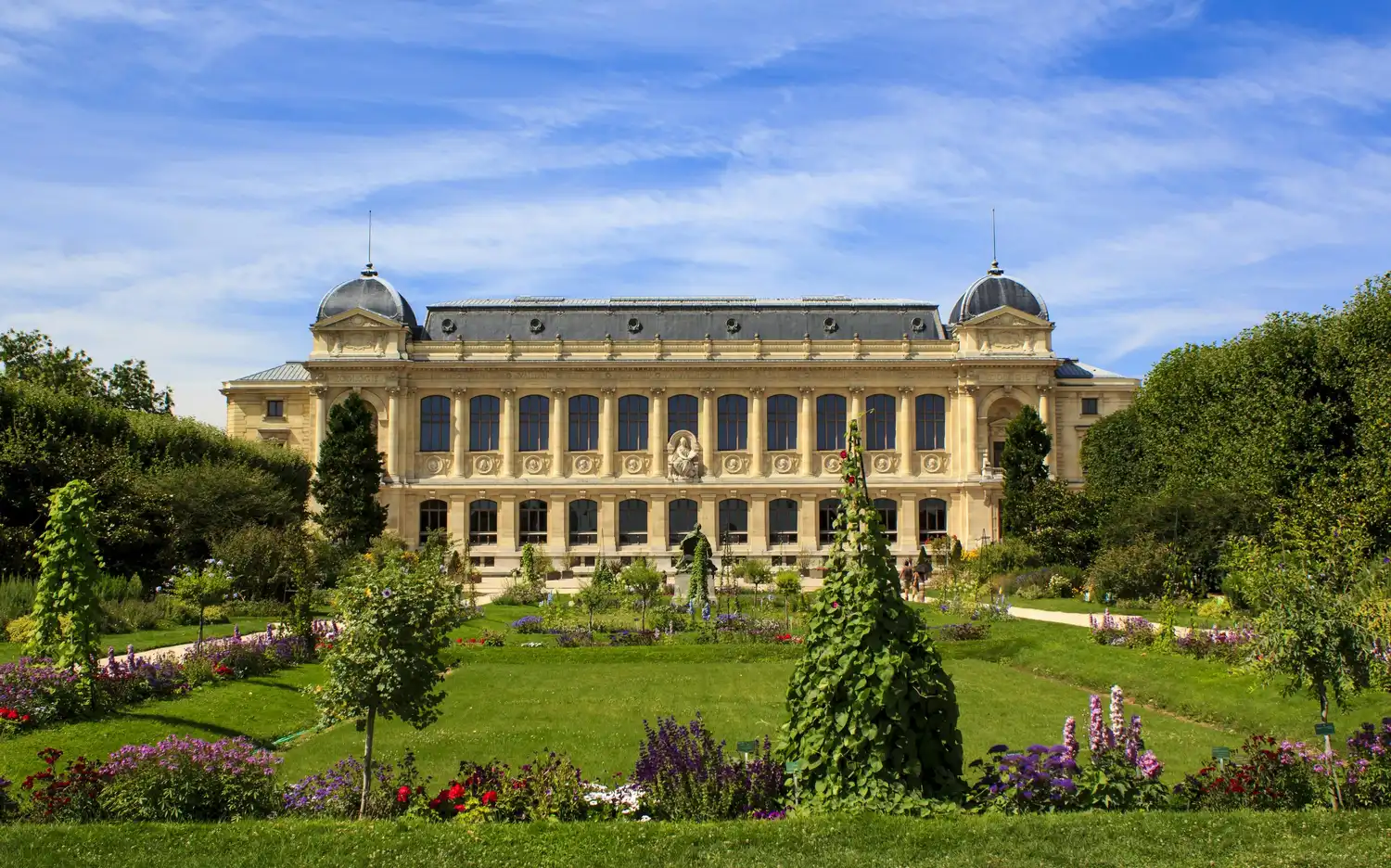
Ornate domed building with large windows, framed by lush gardens and colorful flower beds under a blue sky.

Grande Galerie de l'Évolution

  • Paris

Journey through a spectacular 19th-century hall in Paris, where over 7,000 preserved specimens come to life under a magnificent glass roof. The Grande Galerie de l'Évolution offers one of the most immersive exhibitions in the city, tracing the profound story of biodiversity and the natural world.

The Grande Galerie de l’Évolution, a crown jewel of the Muséum national d’histoire naturelle, is an architectural and scientific masterpiece situated within the historic Jardin des Plantes in the 5th arrondissement. Originally inaugurated in 1889 as the Galerie de Zoologie, the building was designed by architect Louis-Jules André to house the burgeoning royal collections of natural history. After falling into a period of neglect and closing in 1966, it underwent a visionary renovation and reopened in 1994 with its current name. Today, it stands as a testament to the French Revolution's commitment to public education and the long-standing French tradition of meticulous naturalist study.

The gallery’s most striking feature is its breathtaking 19th-century iron and glass architecture. At its heart lies a massive central hall topped by a magnificent 1,000-square-meter glass roof, which floods the space with shifting natural light. This historic structure is artfully integrated with modern scenography, including a sophisticated sound and light system that periodically simulates the rhythms of nature, such as a tropical thunderstorm. The interior is defined by three tiers of ornate balconies that look down upon the ground floor, creating a sense of immense scale and transparency that blurs the lines between a traditional museum and a dramatic stage set.

Upon entering, visitors are greeted by the spectacular Parade of Species, a poetic procession of life-sized taxidermied animals—including an iconic African elephant, giraffes, and lions—marching across the central floor as if boarding a modern-day Noah’s Ark. The experience is meticulously organized across four levels to tell the story of biodiversity and evolution. The ground floor and first level plunge visitors into the marine and terrestrial worlds, while the upper levels shift the focus to human impact on the environment and the scientific theories of evolution championed by figures like Charles Darwin and Jean-Baptiste Lamarck.

The atmosphere within the gallery is one of quiet awe, where the "world of silence" in the marine section gives way to the grand spectacle of the savannah. A particularly poignant stop for many is the Salle des Espèces Menacées et des Espèces Disparues (Room of Endangered and Extinct Species), which houses rare specimens like the dodo and the quagga, serving as a powerful reminder of the fragility of life. Whether marveling at the giant blue whale skeleton or the intricate displays of colorful butterflies, visitors are invited into a deep, emotional connection with the natural world, framed by the timeless elegance of Parisian history.

Highlights

  • The African Savannah gallery features a stunning procession of life-sized animals like elephants, giraffes, and lions.
  • The Spectrum of Life exhibit showcases the immense diversity of over 1,500 specimens across a 100-foot-long installation.
  • The Endangered and Extinct Species area highlights rare specimens like the giant squid and the long-lost dodo bird.
  • The Great Hall of Evolution itself is an architectural masterpiece with a massive 19th-century glass roof and ornate ironwork.
  • The Marine World section takes visitors on a journey through the depths of the ocean with skeletons and models of giant sea creatures.

Must-Dos

  • Look up and observe the shifting light sequences that mimic a day’s progression from dawn to dusk across the glass roof.
  • Pause on the upper balconies to capture a bird's-eye perspective of the animal procession below.
  • Engage with the interactive kiosks scattered throughout the galleries to discover the scientific history behind individual specimens.
  • Visit the Children's Gallery on the first floor for hands-on activities designed to explore biodiversity through touch and play.
  • Examine the intricate ironwork details of the 19th-century staircases to appreciate the industrial artistry of the era.
  • Listen for the ambient soundscapes integrated into the exhibits that recreate the natural noises of wild habitats.

Guidelines

  • All visitors must undergo security controls and baggage checks at the entrance as part of the Vigipirate program.
  • The museum is strictly closed on Tuesdays, as well as on January 1, May 1, and December 25.
  • You may take non-flash photography and videos for private, non-commercial use within the galleries.
  • The use of flash, tripods, and selfie sticks is prohibited inside the museum to protect the specimens and other visitors.
  • Large items such as backpacks, rigid baby packs, and long umbrellas must be checked at the entrance before entering the galleries.
  • Eating, drinking, and smoking are not permitted inside the museum galleries to ensure the preservation of the collections.
  • Last admission to the ticket desks is 45 minutes before closure, so ensure you arrive early to complete your visit.

Tips

  • Purchase your tickets exclusively online in advance for prices ranging from 7 to 14 euros to ensure entry, as the museum is closed on Tuesdays.
  • Visit during weekday mornings to experience the 7,000 specimens without the large crowds that often form during peak hours.
  • Enter the Jardin des Plantes through the entrance at 36 Rue Geoffroy-Saint-Hilaire for the most direct access to the gallery's esplanade.
  • Arrive at least 15 to 30 minutes before your scheduled time slot to account for mandatory security checks that apply to all visitors.
  • Consider using the Paris Museum Pass for entry to the permanent collections, but remember that a separate reservation for a time slot is still required.
  • Plan to spend at least half a day if you are visiting with children to fully explore the interactive wonders and the nearby Ménagerie zoo.
  • Take advantage of the free access to the surrounding botanical gardens, such as the School of Botany and Rose Garden, before or after your gallery visit.

Why Visit

The Grande Galerie de l'Évolution is a masterclass in immersive storytelling, where the rigid world of traditional natural history is replaced by a cinematic journey through the living world. Stepping inside, you are instantly humbled by the sheer scale of the grand parade, a majestic, frozen march of creatures that feels less like a museum exhibit and more like a high-stakes encounter in the wild. This isn't just about looking at specimens; it's about witnessing the undeniable connection between all life forms, showcased with a dramatic flair that only Paris could provide.

The experience is a profound sensory awakening, where the environment itself breathes alongside the exhibits. As the vast glass roof filters the changing Parisian sky, the synchronized soundscapes transport you from the depths of a blue-lit oceanic abyss to the electric tension of a tropical storm on the savannah. There is a haunting beauty in the Room of Endangered Species, a place of quiet reflection that makes the fight for our planet’s future feel personal and urgent. Every corner of this iron-and-glass jewel box is designed to evoke a sense of wonder and responsibility, turning a simple afternoon walk into an unforgettable emotional odyssey.The Grande Galerie de l'Évolution is a theatrical triumph of nature and science, transforming the study of life into a breathtaking, multisensory encounter that will forever alter how you view your place in the natural world.

When to Visit

Midweek Safari in the Jardin des Plantes

Steer clear of the heavy weekend foot traffic by scheduling your visit for Wednesday morning or Thursday morning. Arriving precisely at 10:00 AM when the doors open ensures you can witness the Great Gallery of Evolution before school groups and tourist crowds peak in the early afternoon. If you prefer a later start, the final two hours before the 6:00 PM closing time often provide a second window of relative calm, especially on Mondays and Tuesdays.

Shifting Spectra Under the Glass Ceiling

Lighting plays a transformative role in this venue, as the massive 19th-century glass roof allows natural light to interact with the museum's sophisticated interior illumination. Plan your walk through the African Savannah gallery during the late afternoon to observe the automated light sequences that simulate a day’s progression from dawn to dusk. Visiting during a sunny afternoon creates a dramatic interplay of shadows and highlights across the specimens, while an overcast day provides a softer, more even glow that is ideal for appreciating the intricate textures of the 7,000 preserved animals.

How to Visit

Finding your way to the Grande Galerie de l'Évolution is a treat in itself, as it is tucked away within the historic Jardin des Plantes. To save yourself a bit of walking, head for the entrance at 36 Rue Geoffroy-Saint-Hilaire. This brings you right to the museum's doorstep without having to navigate the entire park first. Budgeting your time here is key; most visitors find that two hours is the sweet spot to see the main galleries, though families with curious kids should definitely set aside at least three hours to allow for interactive play.

Navigating the Evolutionary Path

To make the most of the layout, I recommend a bottom-up approach that follows the narrative of life on Earth. Starting in the dim, atmospheric basement sets the stage before you emerge into the light of the upper levels.

  • Begin at Level 0 to explore the Marine World, where you can walk among giant squids and the impressive skeleton of a southern right whale.
  • Take the stairs or lift to Level 1 to join the Great Parade. This is the heart of the museum, where a massive caravan of African wildlife appears to march across the hall.
  • Move up to the balconies on Levels 2 and 3 to look at the history of organisms and the impact humans have had on biodiversity, ending with the poignant displays of extinct animals.

Pro-Tips for a Smooth Discovery

Since the museum is part of a larger complex, you can easily turn this into a full-day adventure. If you have any energy left after the main gallery, your ticket often allows for a combined visit to the Galerie de Minéralogie nearby. Also, keep in mind that the upper floors are generally much quieter than the main parade on the first floor, offering a peaceful retreat if the main hall gets a bit lively with school groups. For those visiting with little ones, the Children's Gallery on the first floor is a fantastic spot for hands-on learning, but remember that it often requires a separate booking or a small top-up on your entry fee.

Schedules

Opening Hours

  • The Grande Galerie de l'Évolution is open from 10:00 AM to 6:00 PM every day except Tuesday.
  • The museum remains closed on January 1st, May 1st, and December 25th.
  • Last entry for visitors is permitted until 5:15 PM, which is 45 minutes before the daily closing time.

Special Days

The venue is closed annually on January 1st, May 1st, and December 25th.

Admission is free for all visitors on the first Sunday of every month throughout the year.

The museum remains open on most other public holidays, including Easter Monday, Ascension Day, and Bastille Day.

How to get there

Nestled in the heart of the 5th arrondissement within the historic Jardin des Plantes, the Grande Galerie de l’Évolution is an easily accessible architectural jewel just a stone's throw from the left bank of the Seine. This central location ensures that visitors can reach the museum seamlessly via a variety of Parisian transit networks.

  • Metro: Line 5 to Gare d'Austerlitz, Line 7 to Censier-Daubenton or Place Monge, and Line 10 to Jussieu or Gare d'Austerlitz.
  • RER: Line C to Gare d'Austerlitz.
  • Bus: Lines 24, 57, 61, 63, 72, 89, and 91 to Gare d'Austerlitz or line 67 to Buffon-La Mosquée.
  • Batobus: Seasonal river shuttle service to the Jardin des Plantes stop.
Directions

Frequently Asked Questions about Grande Galerie de l'Évolution

Yes, free self-service lockers are available near the entrance of the Grande Galerie de l'Évolution in the Jardin des Plantes. However, for security reasons under the 'Vigipirate' plan, large suitcases and bulky items exceeding 55x35x20 cm are strictly prohibited and cannot be stored on-site.
The museum is fully accessible, featuring elevators that serve all four levels of the evolution exhibition. Visitors with strollers or limited mobility can easily navigate the historic architecture to view the 'Parade of Species' and the marine life displays.
The most iconic photo location is from the upper balconies looking down at the 'Parade of Species' on the ground floor. This vantage point perfectly captures the 19th-century iron structure, the life-sized taxidermy, and the glow from the 1,000-square-meter glass roof.
Yes, the 'Galerie des Enfants' is a specific interactive area within the Muséum national d'histoire naturelle that requires a separate timed-entry ticket. While the main evolution exhibition is suitable for all ages, the Children's Gallery offers specialized hands-on science displays for kids aged 6 to 12.
Rare and extinct specimens, including the famous dodo and the quagga, are housed in the 'Salle des Espèces Menacées et des Espèces Disparues' (Room of Endangered and Extinct Species). This section is designed with lower light levels to preserve these delicate taxidermy treasures of natural history.
To fully appreciate the four levels of wildlife displays and the immersive sound and light system, visitors should allocate at least 2 hours. If you plan to explore the surrounding Jardin des Plantes or other galleries of the Muséum national d'histoire naturelle, a half-day visit is recommended.
While there is no full restaurant inside the Grande Galerie de l'Évolution, a small cafeteria is located on the first floor offering light snacks and drinks. For a more substantial meal, several kiosks and the 'Belles Plantes' restaurant are situated just steps away within the Jardin des Plantes.
To experience the museum's quiet awe and avoid school groups, it is best to visit on weekday mornings immediately after opening at 10:00 AM or late Wednesday afternoons. Weekends and French school holidays tend to be the busiest times for this popular Paris attraction.
Personal photography is allowed throughout the gallery; however, the use of flash and tripods is strictly forbidden. This policy helps protect the sensitive taxidermy specimens and ensures the immersive 'sound and light' sequences remain undisturbed for other guests.
Archaeological artifacts from the Seine riverbed displayed in the underground crypt beneath Notre-Dame cathedral.
Sculptures of 20th-century conflict in the modernist Ateliers-musee Chana Orloff gallery in Paris.
Recommended
Digital art projections of Da Vinci and Michelangelo masterpieces illuminate a large immersive gallery space.
A selection of delicate pencil and pastel sketches by Pierre-Auguste Renoir displayed in a gallery.
Antique Korean beauty accessories and traditional paintings displayed in a modern museum gallery at Musée Guimet.
Vibrant interactive garden chapter at Cité des sciences featuring lush plants and sensory science displays.
Recommended
Elegant 18th-century gowns and contemporary couture on display in a grand gallery at Palais Galliera.
Recommended
Mannequins display vibrant contemporary African haute couture and textiles in a modern gallery space.
Vibrant avant-garde artwork and a Dreamachine light installation on display at the Brion Gysin exhibition in Paris.
Musicians perform an open-air concert on a stage surrounded by the lush trees of Jardin d'Acclimatation in Paris.
Recommended
Vibrant oil painting of a couple dancing outdoors in a sunlit, crowded Parisian cafe by Pierre-Auguste Renoir.
Self-portrait of Gustave Courbet with his black dog at the Artists’ Faces exhibition in the Petit Palais.
Recommended
Visitors walk among sculptures in the vaulted glass hall of Musée d'Orsay, with others seated on benches.
4 exhibitions

Musée d'Orsay

  • Paris

Breathtaking Impressionist masterpieces housed within the timeless elegance of a magnificent Parisian station.

Recommended
Modern curved glass and metal Fondation Louis Vuitton building under a blue sky with trees and parked cars.
1 exhibition

Fondation Louis Vuitton

  • Paris

Where avant-garde art meets Frank Gehry’s breathtaking glass sails in the heart of Paris.

Recommended
Grand mansion at Musée Rodin viewed through manicured gardens with a central pond, statues, and trimmed bushes.
1 exhibition

Musée Rodin Paris

  • Paris

A historic mansion sanctuary where Rodin’s emotive masterpieces breathe amidst rose-filled gardens.

Recommended
Ornate stone Musée de l'Orangerie entrance with large columns and one person standing near the doorway.
2 exhibitions

Musée de l'Orangerie

  • Paris

A luminous sanctuary where Monets panoramic Water Lilies bloom in timeless Impressionist light.

Recommended
Grand neoclassical Palais Garnier with golden statues and a French flag under a blue sky.
1 exhibition

Palais Garnier

  • Paris

A breathtaking masterpiece of nineteenth-century opulence and legendary Parisian high culture.

Recommended
Vibrant abstract projections from the Kandinsky exhibition at the Atelier des Lumières digital art center.
1 exhibition

Atelier des Lumières

  • Paris

Masterpieces come alive through immersive light and sound in a historic Parisian foundry.

Recommended
Intricate metal framework of a large glass dome casting shadows on a mural of historical and mythical scenes.
1 exhibition

Bourse de Commerce - Pinault Collection

  • Paris

A sanctuary of contemporary masterpieces housed within a masterfully restored historic dome.

Neoclassical building with tall columns, large windows, outdoor seating, and a statue holding a spear.
2 exhibitions

Musée d'Art Moderne de Paris

  • Paris

A sanctuary of avant-garde masterpieces and evolving contemporary narratives in the heart of Paris.

Historic courtyard at Musée de l'Armée with arched windows and a golden-domed building under a partly cloudy sky.
1 exhibition

Musée de l'Armée & Napoleon's Tomb

  • Paris

France's storied military legacy rests beneath a majestic golden dome of timeless architectural grandeur.

Grand building with arched windows, statues, and a central fountain, surrounded by lawns and city buildings.
2 exhibitions

Palais Galliera

  • Paris

A grand Renaissance palace enshrining the timeless evolution of French fashion and contemporary artistry.

Exhibit wall with multilingual text about Georges Méliès, surrounded by framed portraits and illustrations.
1 exhibition

La Cinémathèque Française

  • Paris

A stunning Frank Gehry masterpiece housing the world's most prestigious collection of cinematic treasures.

Elegant stone mansion with arched doorways and a columned entrance, set within a manicured courtyard.
1 exhibition

Musée Jacquemart-André

  • Paris

An opulent Haussmann-era mansion housing one of the city's most prestigious private art collections.