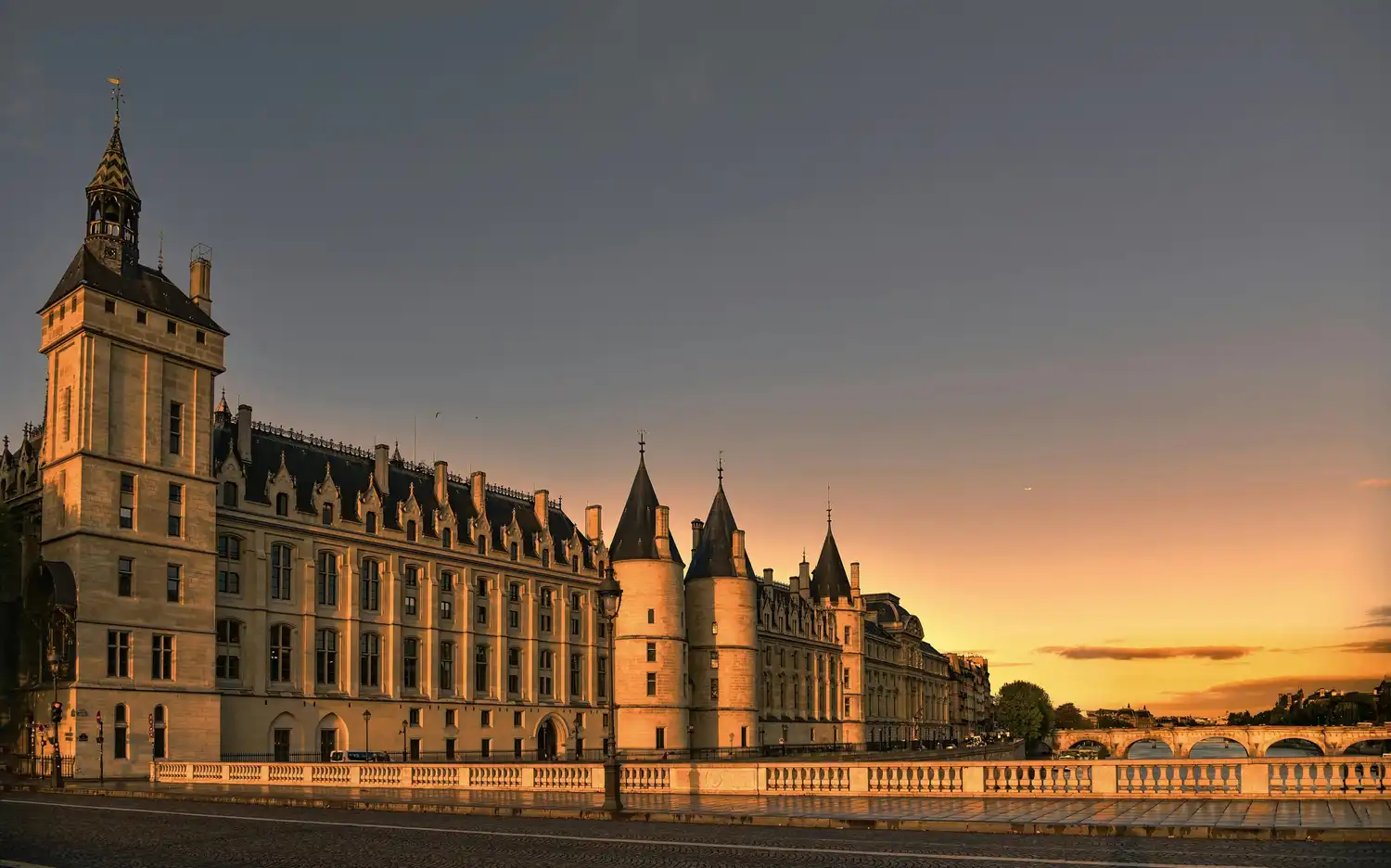
Historic Conciergerie with towers along the Seine at sunset, featuring a bridge under a clear sky.

Conciergerie

  • Paris

Step into the Conciergerie on Paris's Île de la Cité, a breathtaking Gothic landmark that transitioned from a medieval royal palace to a notorious Revolutionary prison. This historic site now hosts captivating cultural exhibitions, preserving the haunting legacy of the Reign of Terror within its majestic halls.

Standing as a formidable Gothic sentinel on the banks of the Seine, the Conciergerie is one of the most evocative landmarks in the heart of Paris. Located on the Île de la Cité, this site has served as a nucleus of power since Gallo-Roman times, evolving from the first medieval royal palace, the Palais de la Cité, into a pivotal seat of justice and, eventually, a notorious prison. Its deep-rooted historical significance is recognized as a UNESCO World Heritage site, representing a transition from the regal splendor of the Capetian kings to the harrowing judicial terror of the French Revolution.

Architecturally, the monument is a rare and stunning example of 13th and 14th-century secular Gothic architecture. Visitors are immediately struck by the immense Salle des Gens d’Armes (Hall of the Men-at-Arms), the largest non-religious Gothic hall in Europe, featuring soaring vaulted ceilings, massive pillars, and four original fireplaces. Other medieval survivors include the Salle des Gardes (Guards Room) and the expansive kitchens built under John the Good. The exterior is equally iconic, characterized by its four dramatic towers—the Tour de l’Horloge, which houses the city’s first public clock, and the medieval Caesar, Silver, and Bonbec towers.

The atmosphere within the Conciergerie shifts dramatically as one moves into the areas dedicated to its time as a revolutionary prison, famously dubbed the Antechamber of the Guillotine. The air grows more somber in the reconstructed cells where thousands of prisoners awaited their fate before the Revolutionary Tribunal. The most poignant space is the Marie-Antoinette Memorial Chapel, built during the Restoration on the exact site of the former queen’s cell. Here, the weight of history is palpable, offering a quiet, reflective space to contemplate the tragic final days of France’s most famous prisoner.

A visit today offers a profound emotional journey through the layers of French history. Through the use of interactive tools like the Histopad, visitors can witness augmented reality reconstructions of the medieval palace life and the stark realities of the revolutionary era. Whether you are marvelling at the mastery of medieval masonry or walking the same stones as Robespierre and Marie-Antoinette, the Conciergerie provides a hauntingly beautiful and comprehensive look at the dramatic evolution of the French state.

Highlights

  • The Salle des Gens d'Armes is the largest surviving medieval Gothic hall in Europe, featuring a forest of pillars and ribbed vaults.
  • The Marie Antoinette Chapel was built during the Restoration on the exact site of the former queen's prison cell.
  • The Salle des Gardes served as the guard room for the sovereign and showcases impressive 14th-century Gothic architecture.
  • The Prisoners' Corridor offers a somber look at the conditions of detention and the names of thousands of victims of the Revolutionary Tribunal.
  • The Medieval Kitchens contain four massive fireplaces once used to prepare feasts for the royal court.
  • The Hall of Names lists the 2,780 individuals sentenced to death by the revolutionary court within these very walls.

Must-Dos

  • Gaze upwards from the quay to appreciate the imposing medieval towers, particularly the Bonbec, Silver, and Caesar towers that have guarded the Seine for centuries.
  • Step into the Women’s Courtyard to find the quiet fountain where prisoners once washed their clothes and took their final breaths of fresh air.
  • Use the Histopad augmented reality tablet to virtually scan the rooms and visualize the opulent banquets and stark prison life of the 14th and 18th centuries.
  • Peer through the iron bars of the reconstructed clerk’s office to imagine the frantic bureaucratic recording of prisoners during the height of the Terror.
  • Pause at the Grooming Room where the condemned had their hair shorn and shirt collars cut before being led out to the waiting tumbrels and the guillotine.
  • Examine the intricate stonework of the twin spiral staircases to discover the hidden craftsmanship that connected the royal apartments to the administrative halls.

Guidelines

  • All visitors must undergo security checks and bag inspections at the entrance to ensure a safe environment.
  • Personal photography and video recording are permitted without the use of a flash, tripods, or selfie sticks.
  • Bags and backpacks are allowed inside provided they do not exceed the maximum size of 40cm x 20cm x 55cm.
  • Strictly prohibited items include weapons, firearms, knives, and any large or bulky suitcases.
  • The consumption of food, alcoholic beverages, and the use of glass containers are not allowed within the monument.
  • Smoking and vaping are strictly forbidden in all indoor areas and throughout the historic facility.
  • Visitors must maintain a respectful distance from all artwork and historic structures to help preserve the site.

Tips

  • Visit the Conciergerie during the week for a much quieter experience compared to the busy weekends.
  • Buy a joint ticket for both the Sainte-Chapelle and the Conciergerie to save money and simplify your entry process.
  • Plan to visit the Sainte-Chapelle first because it has a stricter timed entry and much longer security lines than the Conciergerie.
  • Arrive early in the morning near the 9:30 AM opening time to beat the large crowds and enjoy the Gothic halls in peace.
  • Make sure to pick up the Histopad augmented reality tablet before 4:30 PM to see interactive recreations of the medieval palace.
  • Check for free admission on the first Sunday of the month between November and March, though you should expect larger crowds on these days.
  • Use the Cité metro station on Line 4 for the most direct and convenient access to the entrance on 2 Boulevard du Palais.

Why Visit

To truly grasp the soul of Paris, one must look beyond the iron lattice of the Eiffel Tower and descend into the stone-carved history of the Conciergerie. This isn't merely a museum; it is a time capsule where the echoes of regal opulence and revolutionary fervor collide. Walking through the Salle des Gens d’Armes, you aren't just a spectator—you are standing in the very heart of the Île de la Cité, surrounded by the staggering architectural ambition of the Middle Ages. By utilizing the HistoPad, the cold stone walls dissolve into vibrant, 360-degree reconstructions, allowing you to witness the dramatic metamorphosis of a monarch's sanctuary into the most feared prison in France.

The air within the Conciergerie carries a unique, somber weight that transitions from the awe-inspiring heights of Gothic arches to the intimate, heartbreaking reality of the revolutionary cells. To stand in the Marie-Antoinette Memorial Chapel is to feel the profound silence of a fallen queen’s final hours, while a visit to the Grooming Room offers a visceral connection to the thousands who were prepared for the guillotine. From the medieval kitchens where royal feasts were forged to the Women’s Courtyard where the condemned caught their last glimpses of the Parisian sky, the experience is an emotional odyssey that reveals the raw, unyielding power of the French spirit.The Conciergerie is an unmissable destination that masterfully bridges the gap between medieval grandeur and the darkest turning points of human history, offering a hauntingly beautiful perspective on the birth of modern France.

When to Visit

Midweek Gothic Solitude

Planning your visit during the week ensures a significantly quieter atmosphere compared to the high-traffic weekends. Arriving exactly at 9:30 am allows you to navigate the Salle des Gens d'Armes before the midday tour groups arrive. If mornings are unavailable, the final entry slot at 5:30 pm provides a brief window to view the revolutionary cells with minimal foot traffic.

Seine-Side Twilight Glow

Photographers should prioritize the exterior quays during the golden hour or at sunset to capture the medieval towers reflecting in the river. The white stone walls of the landmark transition into a warm, metallic hue just as the city's street lamps begin to flicker on. Choosing a morning visit during the blue hour—ideally around 7:00 am to 8:00 am depending on the season—offers the best opportunity for a perfectly still, mirror-like reflection on the Seine before boat traffic creates ripples.

How to Visit

To get the most out of your visit to this medieval masterpiece, plan for about 90 minutes to explore the grounds properly. Since the site is part of a larger complex on the Île de la Cité, you will enter at 2 Boulevard du Palais. If you have pre-booked your tickets, you can bypass the main ticket line, but remember that every visitor must still pass through the mandatory security screening at the entrance.

Navigating the Gothic Halls and Cells

For the most logical flow through the building's layers of history, I recommend following this path to see the primary landmarks:

  • Start in the massive Salle des Gens d'Armes, where the scale of the medieval architecture is most apparent.
  • Head toward the Medieval Kitchens to see the four monumental fireplaces used for royal banquets.
  • Move into the revolutionary section to see the Prisoner’s Gallery and the List of the Condemned.
  • Conclude your indoor tour at the Marie-Antoinette Memorial Chapel before stepping into the Women’s Courtyard.

Digital Keys to the Past

Make sure to pick up the HistoPad at the start of your tour. This tablet is included with your visit and acts as a digital window, using augmented reality to show you exactly how these stone halls looked during the Middle Ages and the Revolution. It is particularly helpful in the Salle des Gardes to help visualize the layout of the former royal palace that once stood above you.

Schedules

Opening Hours

  • The Conciergerie is open every day from 9:30 am to 6:00 pm throughout the year.
  • The last entry to the monument is permitted until 5:30 pm, which is 30 minutes before the scheduled closing time.
  • Visitors should note that the venue remains closed on January 1st, May 1st, and December 25th.

Special Days

The Conciergerie is closed annually on January 1, May 1, and December 25.

Admission is free for all visitors on the first Sunday of each month from November to March and during European Heritage Days.

How to get there

Located on the historic Île de la Cité in the 1st arrondissement, the Conciergerie sits majestically along the banks of the Seine and is easily accessible via Paris's extensive public transport network. This central landmark is well-connected by several major transit hubs, making it a convenient stop for any visitor in the heart of the city.

  • Metro: Line 4 to Cité or Saint-Michel, and Lines 1, 7, 11, and 14 to Châtelet.
  • RER: Lines B and C to Saint-Michel Notre-Dame.
  • Bus: Lines 21, 24, 27, 38, 58, 81, 85, and 96, which all stop at Cité - Palais de Justice or Saint-Michel.
  • Batobus: Disembark at the Notre-Dame stop for a short walk across the bridge to the island.
Directions

Frequently Asked Questions about Conciergerie

For security reasons, large suitcases and bulky bags are not permitted inside this historic monument. Only small bags and personal items are allowed, and there are currently no self-service lockers or cloakrooms available on the Ile de la Cité site.
While the medieval Salle des Gens d'Armes is accessible, other parts of the Palais de la Cité include narrow staircases and uneven floors. Strollers are generally discouraged inside the revolutionary prison sections; it is recommended to use a baby carrier for a more comfortable visit.
The most iconic view is from the Pont au Change at sunset, capturing the four medieval towers reflected in the Seine. Inside, the vaulted ceilings of the Salle des Gens d'Armes provide a stunning example of secular Gothic masonry for interior photography.
Yes, a popular 'joint ticket' is available that grants access to both the Conciergerie and the nearby Sainte-Chapelle. This is the best way to explore the entire former medieval royal palace complex on the Ile de la Cité while saving on admission costs.
The HistoPad is an interactive tablet provided to visitors that uses augmented reality to show 3D reconstructions of the medieval royal palace and the cells as they appeared during the French Revolution, including the exact room where Marie Antoinette was held.
Yes, the Conciergerie is a participating site in the Paris Museum Pass. Cardholders can access the monument by presenting their pass at the entrance, though it is often still necessary to book a specific time slot online to ensure entry.
Located on the corner of the Conciergerie, the Tour de l'Horloge houses the first public clock in Paris, commissioned in 1370. Look for the intricate gold leaf details and the figures representing Law and Justice that flank the historic timepiece.
As the Conciergerie is located within the Palais de Justice complex, all visitors must pass through a security screening similar to an airport. Sharp objects, glass bottles, and large metal items are strictly prohibited to ensure the safety of this UNESCO World Heritage site.
You can visit the Marie-Antoinette Memorial Chapel, which was built on the precise location of the Queen's original cell. The HistoPad also allows you to see a digital reconstruction of her living conditions during her final days in the revolutionary prison.
Recommended
Vibrant satirical photography by Martin Parr exploring global tourism and consumerism at the Jeu de Paume gallery.
Stark black-and-white landscape photography captures the silent aftermath of South African conflict and memory.
Recommended
Mummified human remains and funerary objects in a modern, respectfully lit gallery at the Musee de l'Homme.
Vibrant street performers and colorful Holi festival celebrations at the historic Jardin d'Acclimatation in Paris.
Crowd at Jardin d'Acclimatation celebrating Holi with a vibrant explosion of colorful powders in the Parisian sky.
Archaeological artifacts from the Seine riverbed displayed in the underground crypt beneath Notre-Dame cathedral.
Sculptures of 20th-century conflict in the modernist Ateliers-musee Chana Orloff gallery in Paris.
Recommended
Digital art projections of Da Vinci and Michelangelo masterpieces illuminate a large immersive gallery space.
A selection of delicate pencil and pastel sketches by Pierre-Auguste Renoir displayed in a gallery.
Antique Korean beauty accessories and traditional paintings displayed in a modern museum gallery at Musée Guimet.
Vibrant interactive garden chapter at Cité des sciences featuring lush plants and sensory science displays.
Recommended
Elegant 18th-century gowns and contemporary couture on display in a grand gallery at Palais Galliera.
Recommended
Visitors walk among sculptures in the vaulted glass hall of Musée d'Orsay, with others seated on benches.
4 exhibitions

Musée d'Orsay

  • Paris

Breathtaking Impressionist masterpieces housed within the timeless elegance of a magnificent Parisian station.

Recommended
Modern curved glass and metal Fondation Louis Vuitton building under a blue sky with trees and parked cars.
1 exhibition

Fondation Louis Vuitton

  • Paris

Where avant-garde art meets Frank Gehry’s breathtaking glass sails in the heart of Paris.

Recommended
Grand mansion at Musée Rodin viewed through manicured gardens with a central pond, statues, and trimmed bushes.
1 exhibition

Musée Rodin Paris

  • Paris

A historic mansion sanctuary where Rodin’s emotive masterpieces breathe amidst rose-filled gardens.

Recommended
Ornate stone Musée de l'Orangerie entrance with large columns and one person standing near the doorway.
2 exhibitions

Musée de l'Orangerie

  • Paris

A luminous sanctuary where Monets panoramic Water Lilies bloom in timeless Impressionist light.

Recommended
Grand neoclassical Palais Garnier with golden statues and a French flag under a blue sky.
1 exhibition

Palais Garnier

  • Paris

A breathtaking masterpiece of nineteenth-century opulence and legendary Parisian high culture.

Recommended
Vibrant abstract projections from the Kandinsky exhibition at the Atelier des Lumières digital art center.
1 exhibition

Atelier des Lumières

  • Paris

Masterpieces come alive through immersive light and sound in a historic Parisian foundry.

Recommended
Intricate metal framework of a large glass dome casting shadows on a mural of historical and mythical scenes.
1 exhibition

Bourse de Commerce - Pinault Collection

  • Paris

A sanctuary of contemporary masterpieces housed within a masterfully restored historic dome.

Neoclassical building with tall columns, large windows, outdoor seating, and a statue holding a spear.
2 exhibitions

Musée d'Art Moderne de Paris

  • Paris

A sanctuary of avant-garde masterpieces and evolving contemporary narratives in the heart of Paris.

Historic courtyard at Musée de l'Armée with arched windows and a golden-domed building under a partly cloudy sky.
1 exhibition

Musée de l'Armée & Napoleon's Tomb

  • Paris

France's storied military legacy rests beneath a majestic golden dome of timeless architectural grandeur.

Grand building with arched windows, statues, and a central fountain, surrounded by lawns and city buildings.
2 exhibitions

Palais Galliera

  • Paris

A grand Renaissance palace enshrining the timeless evolution of French fashion and contemporary artistry.

Exhibit wall with multilingual text about Georges Méliès, surrounded by framed portraits and illustrations.
1 exhibition

La Cinémathèque Française

  • Paris

A stunning Frank Gehry masterpiece housing the world's most prestigious collection of cinematic treasures.

Elegant stone mansion with arched doorways and a columned entrance, set within a manicured courtyard.
1 exhibition

Musée Jacquemart-André

  • Paris

An opulent Haussmann-era mansion housing one of the city's most prestigious private art collections.