Plumes Du Paradis
- Musée du quai Branly - Jacques Chirac, Paris
22 May - 8 Nov 2026
From€14.00
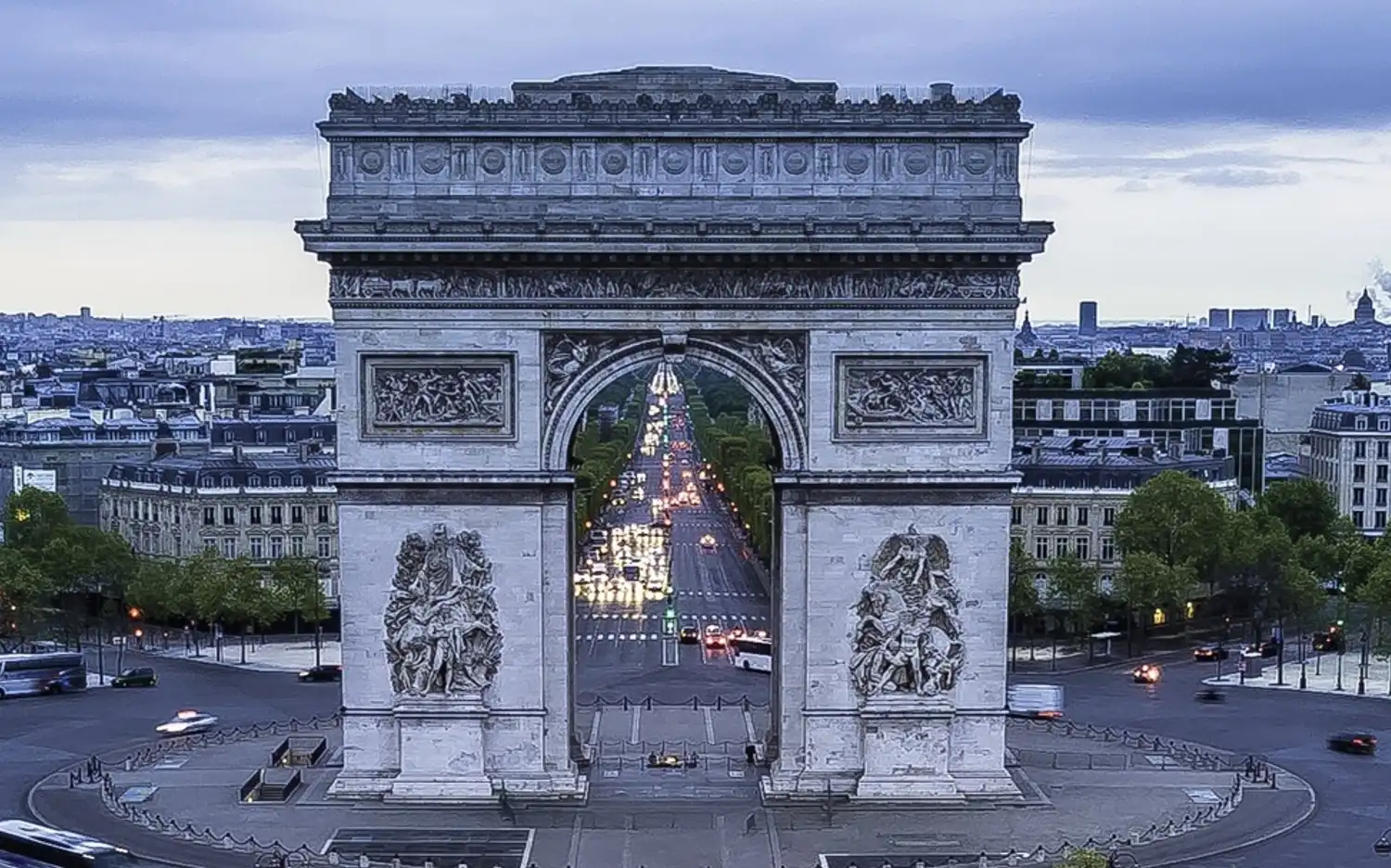
Standing as a monumental gateway at the western end of the Champs-Élysées, the Arc de Triomphe is a profound symbol of French national identity and military glory. Commissioned by Napoleon Bonaparte in 1806 following his decisive victory at the Battle of Austerlitz, this Neoclassical masterpiece was designed by architect Jean Chalgrin to honor the Grande Armée. Though construction spanned three decades and faced numerous political shifts, it was finally inaugurated in 1836 under King Louis-Philippe. Today, it serves as a solemn site of remembrance, housing the Tomb of the Unknown Soldier from World War I, where an Eternal Flame is rekindled every evening to honor those who fell for France.
Architecturally, the monument is a marvel of scale and detail, inspired by the ancient Arch of Titus in Rome but nearly double its size. Its four massive pillars are adorned with intricate high-relief sculptures, most notably François Rude’s "Departure of the Volunteers of 1792," popularly known as La Marseillaise. The inner walls of the great arches are meticulously engraved with the names of 660 military leaders and scores of significant battles from the French Revolutionary and Napoleonic Wars, while the attic features thirty shields representing major victories. This "open book in stone" offers a visual narrative of the country's struggle for peace and its imperial aspirations.
Visitors approaching the arch through the safe underground passage are immediately struck by its commanding presence at the center of Place Charles de Gaulle, formerly known as Place de l'Étoile. The atmosphere is one of grandiosity and historical weight, especially as twelve radiating avenues converge upon the monument like a giant star. Inside, a small museum provides context on its construction and its role as a centerpiece for national celebrations like Bastille Day. The experience is deeply visceral, blending the bustling energy of modern Parisian traffic with the quiet, reverent silence found at the base of the vault.
Ascending the 284 steps of the spiral staircase brings travelers to the panoramic Observation Deck, offering one of the most spectacular vistas in the "City of Light." From this vantage point, the city’s unique Haussmann urban design is laid bare, with the Axe Historique stretching from the Louvre to the modern Grande Arche de la Défense. The view is particularly magical at sunset, as the Eiffel Tower sparkles in the distance and the lights of the Champs-Élysées begin to glow, providing a perfect synthesis of Paris's enduring heritage and its vibrant contemporary life.
Beyond its role as a sentinel of history, the Arc de Triomphe is the true geometric soul of Paris, offering a vantage point that even the Eiffel Tower cannot match. While other monuments let you look at the city, the Arc places you at the very epicenter of its pulse, where twelve grand avenues collide in a breathtaking display of urban symmetry. To stand atop this limestone giant is to witness the Axe Historique in its full glory, a straight line of human ambition stretching from the ancient Louvre to the futuristic skyscrapers of La Défense. It is the only place where you can truly grasp the Haussmann vision that transformed Paris into the world's most beautiful city, all while feeling the literal weight of centuries beneath your feet.A Sensory Journey Through the Heart of the Etoile
The ascent is a physical dialogue with the past, where the cool, narrow winding of the 284 spiral steps builds a mounting sense of anticipation that culminates in a sudden, explosive release into the Parisian sky. On the rooftop, the air carries the distant hum of the swirling Place Charles de Gaulle traffic below, a chaotic urban ballet that contrasts sharply with the reverent stillness of the eternal flame flickering at the base. As the golden hour sets in, the white stone of the arch seems to soak up the amber light, and the city’s lights begin to flicker on like a rising tide of diamonds, creating a sensory tapestry that blends the solemnity of a war memorial with the electric vitality of a modern metropolis.The Arc de Triomphe is not merely a monument to be seen, but a living bridge between the shadows of French valor and the sparkling, boundless horizon of the City of Light.
Morning Sentinel Ascent
Arriving at the monument entrance exactly at 10:00 AM provides the best opportunity to clear security and reach the rooftop before the primary tour groups arrive. Early morning visits yield the most consistent natural lighting for the Neoclassical details of the arch's facade without the heavy glare from the midday sun. Securing a spot on the panoramic terrace during the first hour of operation ensures a quieter environment to view the twelve radiating avenues before the high-traffic period begins around 1:00 PM.
Twilight Over the Twelve Avenues
Timing your climb for roughly 45 minutes before sunset allows you to witness the city transition as the sky shifts to a deep blue. This specific window is ideal for seeing the Eiffel Tower's first sparkle of the evening, which occurs exactly on the hour once night has fallen. The artificial illumination of the Champs-Elysees typically glows brightest after 8:00 PM, creating the high-contrast light trails from the traffic below that are synonymous with the Paris night aesthetic.
Off-Peak Weekday Entry
Scheduling your visit on a Tuesday, Wednesday, or Thursday typically results in shorter wait times at the underground tunnel entrance on the Champs-Elysees side. The monument stays open until 11:00 PM from April to September, making a late-night ascent an effective way to avoid the congestion found during the core daylight hours. Choosing a time after 9:30 PM minimizes the presence of school groups and large sightseeing parties, offering a more peaceful perspective of the Tomb of the Unknown Soldier and the eternal flame.
Visiting the Arc de Triomphe is a quintessential Paris experience, but the chaotic 12-lane roundabout surrounding it can be intimidating for first-timers. The most important rule for a stress-free visit is to never attempt to cross the traffic at street level. Instead, look for the safe, dedicated pedestrian access.
Subterranean Secrets to the Summit
To reach the monument, head to the north side of the Champs-Élysées or the Avenue de la Grande Armée and locate the stairs leading to the Passage du Souvenir. This underground tunnel is the only authorized way to reach the base of the arch without risking a real-life game of Frogger. Once you emerge from the tunnel, you'll be directly under the massive vault. Budget about 1.5 to 2 hours for the total experience, especially if you plan to conquer the 284-step climb to the top.Navigating the Neoclassical Giant
Beating the Parisian Rush
While the landmark is a magnet for crowds, you can find a bit of breathing room by aiming for a visit during the mid-week lull. After you've taken in the views from the summit, use the tunnel to return to the Champs-Élysées side for a leisurely walk toward the Tuileries. If you happen to be there at 6:30 PM, you can witness the daily flame-rekindling ceremony at the base, which is a moving piece of living history that many travelers overlook in their rush to reach the rooftop.
The monument is closed all day on January 1st, May 1st, and December 25th.
Opening is delayed until the afternoon on May 8th, July 14th, and November 11th due to official ceremonies.
Admission is free for everyone on the first Sunday of every month from November to March.
Located majestically at the center of the Place Charles de Gaulle in the 8th arrondissement, the Arc de Triomphe serves as the grand western anchor of the Champs-Élysées. This iconic landmark is exceptionally accessible from across the capital, sitting directly atop one of Paris's most vital transport hubs.
Complete your cultural itinerary with the 10 other top-rated exhibitions in Paris in 2026.
Explore the 9 other top-rated cultural attractions to visit in Paris in 2026.