
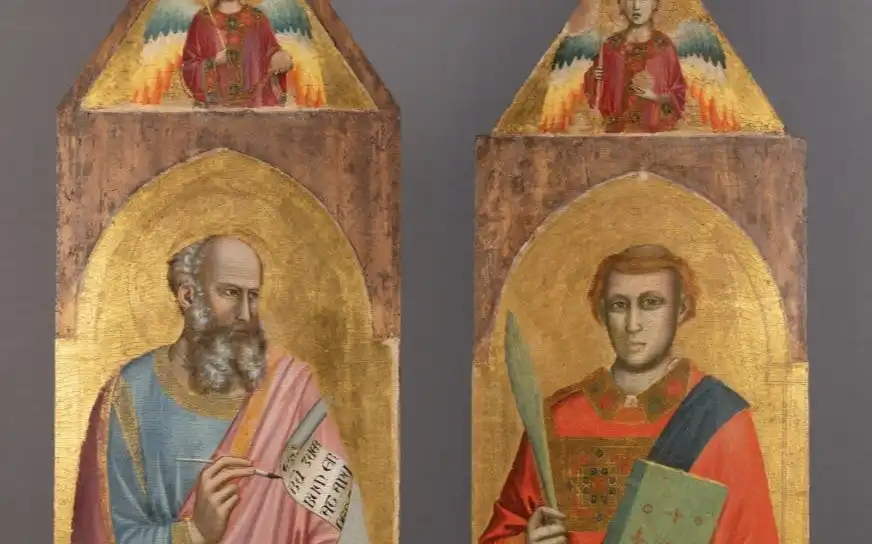


The temporary exhibition at the Château de Chantilly represents a momentous curatorial achievement, bringing together the rare and foundational works of Giotto di Bondone, widely regarded as the father of Western painting. Centered in the recently restored Cabinet du Giotto within the Musée Condé’s Logis wing, the showcase revolves around two early 14th-century masterpieces acquired by the visionary collector Nélie Jacquemart. This marks a unique homecoming for these panels, allowing them to be viewed in a high-prestige, intimate setting that emphasizes their transition from the stylized Byzantine tradition toward a more profound, human-centric naturalism.
The curatorial narrative thoughtfully places these primary works—including the revered Saint Jean l’Évangéliste and Saint Laurent—alongside pieces by Giotto’s pupils and later admirers. By integrating these with the permanent collection of the Duc d'Aumale, such as the Dormition of the Virgin (now attributed to the Giottesque master Maso di Banco), the exhibition traces the lineage of the Tuscan school. This dialogue between the Jacquemart-André treasures and the Condé collections highlights the historical significance of Giotto’s innovation in perspective, volume, and emotional weight, which paved the way for the Italian Renaissance.
Visitors are invited to experience the emotional resonance inherent in Giotto’s revolutionary approach to the human figure. The solemnity and tangible presence of the saints on display evoke a sense of quietude and spiritual gravity, bridging the gap between the divine and the terrestrial. This exhibition is not merely a display of medieval panels but a celebration of the humanization of art, where the physical presence and psychological depth of the subjects resonate across seven centuries. It serves as a powerful reminder of how a single artist's vision can fundamentally alter the course of cultural history and the collective aesthetic consciousness.
Highlights
- Experience the rare reunion of two early 14th-century masterpieces by Giotto di Bondone on loan from the Domaine de Chaalis.
- Explore the newly restored Cabinet du Giotto in the Logis wing, a room specifically renamed to honor the father of Western painting.
- Compare the master’s work with The Dormition of the Virgin, a powerful panel once attributed to Giotto and now recognized as a work by his pupil Maso di Banco.
- Discover the refined detail of Italian illumination through the depictions of the evangelists Saint Matthew and Saint Mark.
- Admire foundational works of the Italian Renaissance collected by the Duke of Aumale, showcased in a unique 19th-century museography.
- Witness the evolution of Western naturalism through the expressive figures and architectural depth created by Giotto and his most devoted followers.
Frequently Asked Questions about The Giotto from the Musée Jacquemart: André du Domaine de Chaalis
Château de Chantilly
- Chantilly
Located just a few kilometers from Paris, the Château de Chantilly offers an opulent glimpse into princely life through the masterpieces of the Musée Condé and its historic exhibitions. This architectural jewel houses a world-renowned collection of paintings and a legendary library featuring the world’s most precious illuminated manuscripts.
Schedules
Opening Hours
- The Château de Chantilly is open from 10:00 to 18:00 during the high season and from 10:30 to 17:00 in the low season.
- The estate remains closed on Tuesdays and during its annual closure in January.
- Final admission to the site is permitted until one hour before the scheduled closing time.
Special Days
The estate remains closed every Tuesday and has scheduled annual closures from January 5 to 23, 2026 and on September 13, 2026.
Public holidays such as May 1st, May 8th, and Ascension Day are open for visitors, and entry is always free for children under 7 years old.
How to get there
Located in the lush valley of the Nonette, just north of the capital, the Château de Chantilly offers a princely escape within easy reach of the city's main hubs. This historic estate is remarkably accessible via France's efficient rail network, making it a favored day trip for those seeking a blend of art and equestrian heritage.
- Train: Take a TER (Regional Express Train) from Paris Gare du Nord to the Chantilly-Gouvieux station, which is the fastest option with a journey time of approximately 25 minutes.
- RER: Use RER Line D towards Creil and disembark at the Chantilly-Gouvieux station; while more frequent, this route typically takes about 45 minutes from the center of Paris.
- Bus: From the Chantilly-Gouvieux station, you can reach the chateau by taking the free DUC (Desserte Urbaine Cantilienne) bus or the Bus 645 towards Senlis, both stopping at the Château or Notre-Dame stations.