
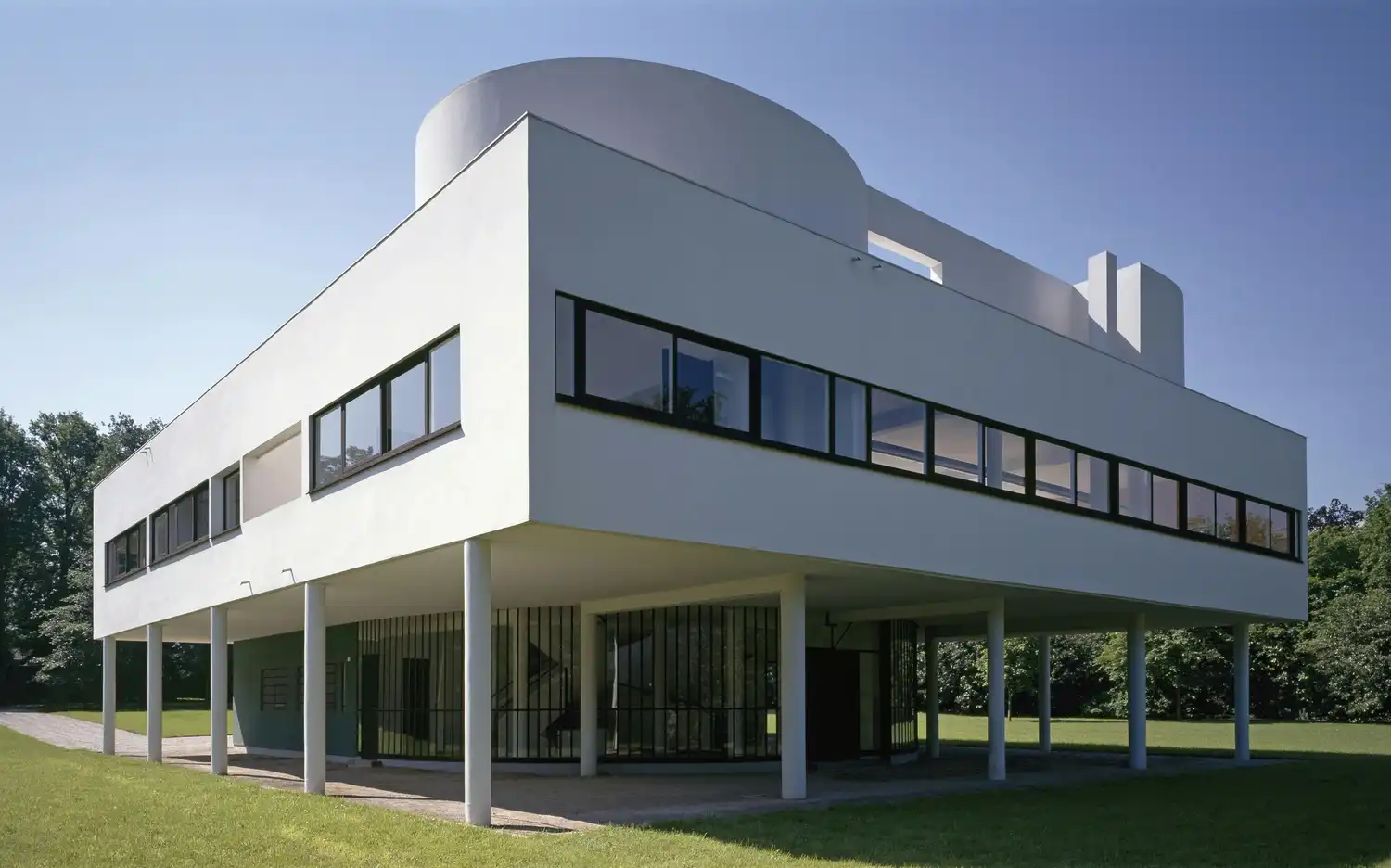
Located in the verdant suburb of Poissy, the Villa Savoye stands as the definitive manifesto of modern architecture. Completed in 1931 by the visionary Swiss-French architect Le Corbusier and his cousin Pierre Jeanneret, this "box in the air" was commissioned by Pierre and Eugénie Savoye as a weekend country retreat. Its historical significance is unparalleled, as it represents the physical culmination of Le Corbusier's decade of experimentation and remains one of the most recognizable examples of the International Style. Designated a UNESCO World Heritage Site in 2016, it is a site of pilgrimage for design enthusiasts who come to witness the birth of the architectural principles that define our contemporary built environment.
The villa is the purest expression of Le Corbusier’s Five Points of Architecture, a revolutionary set of tenets that broke away from centuries of traditional building methods. Visitors will see the structure elevated on slender reinforced concrete columns known as pilotis, which lift the living spaces above the ground and allow the garden to extend beneath the house. The free facade and ribbon windows provide an uninterrupted panoramic view of the surrounding greenery, while the free floor plan eliminates the need for load-bearing interior walls. Crowning the building is a functional roof garden and solarium, designed to reclaim the nature occupied by the building's footprint and provide a private sanctuary for sun and air.
Stepping inside, the atmosphere is one of light, movement, and clinical purity. The experience is designed as an architectural promenade, where spaces unfold dynamically as one moves through the building. A central ramp serves as the primary artery, linking the ground-level entrance—curved to match the turning radius of a 1920s automobile—to the luminous first-floor living areas and ultimately the rooftop. Notable features include the minimalist kitchen, the sculptural spiral staircase, and a tiled lounge chair built directly into the floor of the master bathroom. The use of architectural polychromy, with walls painted in specific purist shades, further dematerializes the structure into a series of colored planes.
Today, under the care of the Centre des monuments nationaux, the Villa Savoye offers a serene and intellectual visitor experience. Unlike the ornate palaces of Paris, the villa feels like a "machine for living," characterized by its logic, hygiene, and harmony with the landscape. Wandering through the light-flooded living room or standing on the hanging garden terrace, one feels the radical spirit of the 1930s avant-garde. It is a space where the boundaries between inside and outside are blurred, inviting guests to contemplate how architecture can fundamentally transform the quality of human life.
Highlights
- The white reinforced concrete Pilotis elevate the building, creating an open and functional ground floor for circulation.
- The Horizontal Ribbon Windows stretch across the facade to provide even lighting and panoramic views of the surrounding greenery.
- An internal Ramp connects the different levels of the house, offering a fluid architectural promenade from the entrance to the roof.
- The Roof Garden transforms the top of the villa into a functional outdoor living space while recovering the footprint of the building.
- The Open Floor Plan eliminates the need for load-bearing walls, allowing for a flexible and versatile interior arrangement.
- The Minimalist Living Room features large sliding glass doors that blur the boundary between the indoor and outdoor environments.
Must-Dos
- Step into the ground floor entrance hall to see the iconic freestanding sink and the curved glass walls designed for the turning radius of a 1920s automobile.
- Climb the elegant spiral staircase to appreciate its sculptural geometry and contrast with the linear ramp.
- Marvel at the sky views from the roof terrace through the framed architectural openings that transform the landscape into living art.
- Walk through the verdant park to find the Gardener's Lodge, a rare example of Le Corbusier's "minimum one-family house" design.
- Admire the striking perpendicular layout of the original rosebushes that delicately encircle the imposing white concrete structure.
- Observe the interplay of light and shadow across the pristine white surfaces as the sun moves across the solarium and living spaces.
Guidelines
- Visitors must undergo mandatory security controls at the entrance in accordance with the Vigipirate plan.
- You should avoid bringing large backpacks, bulky luggage, or oversized bags as they are restricted within the heritage interiors.
- Personal photography is permitted using handheld devices, but the use of flash, tripods, monopods, and professional filming equipment is prohibited.
- The last admission to the monument is allowed up to 30 minutes before the scheduled closing time.
- Visitors must maintain a safe distance from all architectural elements and stay on the designated pathways or ramps.
- Guided tours are included with your admission ticket on Saturdays and Sundays at 10:45 am and 3 pm, subject to availability.
Tips
- Arrive at 82 Rue de Villiers about 10 to 20 minutes before the 10:00 opening to enjoy the interior and roof terrace before the midday crowds and group tours arrive.
- Take the RER line A to Poissy station and then catch bus 50 or 6503 toward La Coudraie, getting off directly at the Villa Savoye stop to save time on the walk.
- Visit during the shoulder seasons of late spring or early autumn for the best balance of soft morning light for photos and comfortable temperatures for exploring the outdoor roof gardens.
- Take advantage of free entry on the first Sunday of the month from November through March, though be prepared for slightly higher visitor numbers during these times.
- Plan for a visit duration of about 1 to 2 hours to fully appreciate the architectural details and the permanent exhibits included in your 8 euro or 9 euro admission.
- Check the seasonal schedule before heading out, as the villa closes at 17:00 from September to April and extends its hours until 18:00 between May and August.
- Pack light layers and a reusable water bottle because the indoor spaces can feel warm while the exposed rooftop promenade is subject to wind and sun.
Why Visit
To truly understand the DNA of the modern world, you must venture beyond the gilded haussmannian boulevards of central Paris to the quiet suburb of Poissy. Here, the Villa Savoye reveals itself not merely as a house, but as a bold, white vision of the future that remains as radical today as it was nearly a century ago. Standing before this "box in the air," you aren't just looking at a building; you are witnessing the moment the heavy stone traditions of the past were shed in favor of light, air, and structural daring. It is an essential pilgrimage for anyone who wishes to see how the simple geometry of reinforced concrete and glass could be harnessed to redefine the very concept of "home" into a high-performance "machine for living."
As you ascend the gentle incline of the central architectural promenade, the building begins to breathe. The transition from the shaded ground floor—sculpted by the turning radius of a vintage automobile—to the sun-drenched living quarters is a sensory revelation. You will find yourself mesmerized by the rhythmic interplay of shadow cast across pristine white surfaces and the way the horizontal ribbon windows transform the French countryside into a series of panoramic living canvases. There is a profound sense of liberation in the open floor plan, where the absence of weight-bearing walls creates a fluid, weightless atmosphere. Reaching the roof garden, where the architecture finally dissolves into the sky, you experience a rare harmony between human ingenuity and the natural world, leaving you with an indelible sense of serenity and intellectual awe.Villa Savoye is a breathtaking masterpiece of modernist purity that challenges you to rethink the relationship between architecture, nature, and the ultimate art of living.
When to Visit
Morning Solitude among the Pilotis
Arriving at 82 Rue de Villiers between 10:00 and 10:30 ensures you enter the grounds before the arrival of large student groups and tour buses that typically cluster around midday. Securing an early slot allows for an unobstructed walk through the ground floor entrance hall and the ramp, which often becomes bottlenecked by 11:00. Aiming for a Tuesday, Thursday, or Friday visit generally provides a quieter atmosphere compared to weekends, as the site remains closed every Monday.
Optimal Luminance for Ribbon Windows
Plan your walkthrough between 11:00 and 13:00 to see the modernist interiors saturated with the most consistent natural light. Because Le Corbusier designed the horizontal ribbon windows to provide uniform illuminance, the high midday sun during May through August maximizes the "living" quality of the light across the open floor plan. Late afternoon visits after 16:00 offer a softer glow on the white reinforced concrete facades, though you must factor in the last entry at 17:30 during the high season or 16:30 between September and April.
How to Visit
To make the most of your trip to this architectural icon, plan for a dedicated 1.5 to 2 hours on-site. Since it is located at 82 Rue de Villiers in Poissy, roughly 30 km from central Paris, you should factor in another hour each way if traveling by RER. Once you arrive at the gate, have your mobile tickets ready for the mandatory security check before heading toward the striking white structure.
Navigating the Architectural Promenade
The best way to experience the villa is to follow the natural flow Le Corbusier intended. Start by circling the exterior to see how the Pilotis support the main volume, then enter the ground floor to begin your ascent.
- Start in the Entrance Hall to see the iconic curved glass walls and the freestanding sink.
- Walk up the central Ramp rather than the stairs; this "architectural promenade" is the core of the design.
- Spend time in the massive Living Room, noting the integrated furniture and the way the Ribbon Windows frame the landscape.
- Peek into the Master Bedroom and its open-concept bathroom featuring the famous tiled lounge.
- Finish your journey on the Roof Terrace, which serves as an outdoor room protected by sculptural windbreaks.
Essential Logistics for the Modern Pilgrim
There is only one primary entrance for visitors, so there is no secret gate to find. However, do keep in mind that the site is strictly closed on Mondays. If you are visiting during the summer months (May to August), you have until 18:00 to explore, but in the cooler months, the doors close at 17:00. Always aim to arrive at least 30 minutes before the last entry to ensure you aren't rushed through the final rooms and the garden.
Schedules
Opening Hours
- From May 2 to August 31, Villa Savoye is open from 10:00 to 18:00, with the last entry allowed at 17:30.
- From September 1 to April 30, the venue operates from 10:00 to 17:00, with last access at 16:30.
- The villa remains closed on Mondays and on major holidays including January 1, May 1, and December 25.
Special Days
The monument is closed annually on January 1, May 1, and December 25, and also shuts every Monday.
Villa Savoye remains open on public holidays such as Easter, Ascension Day, May 8, July 14, and August 15.
Entry is free for everyone on the first Sunday of January, February, March, November, and December.
How to get there
Nestled in the lush suburb of Poissy, approximately 30 kilometers west of central Paris, Villa Savoye is an easily accessible pilgrimage site for architecture enthusiasts. While located outside the city's main arrondissements, it remains well-connected via the regional rail network and local bus services.
- RER: Take Line A toward Poissy and disembark at the final station, Poissy.
- Train: Take Line J from Gare Saint-Lazare toward Mantes-la-Jolie and get off at Poissy.
- Bus: From Poissy station, take bus 3 toward La Coudraie or bus 6503 and stop at Villa Savoye.