
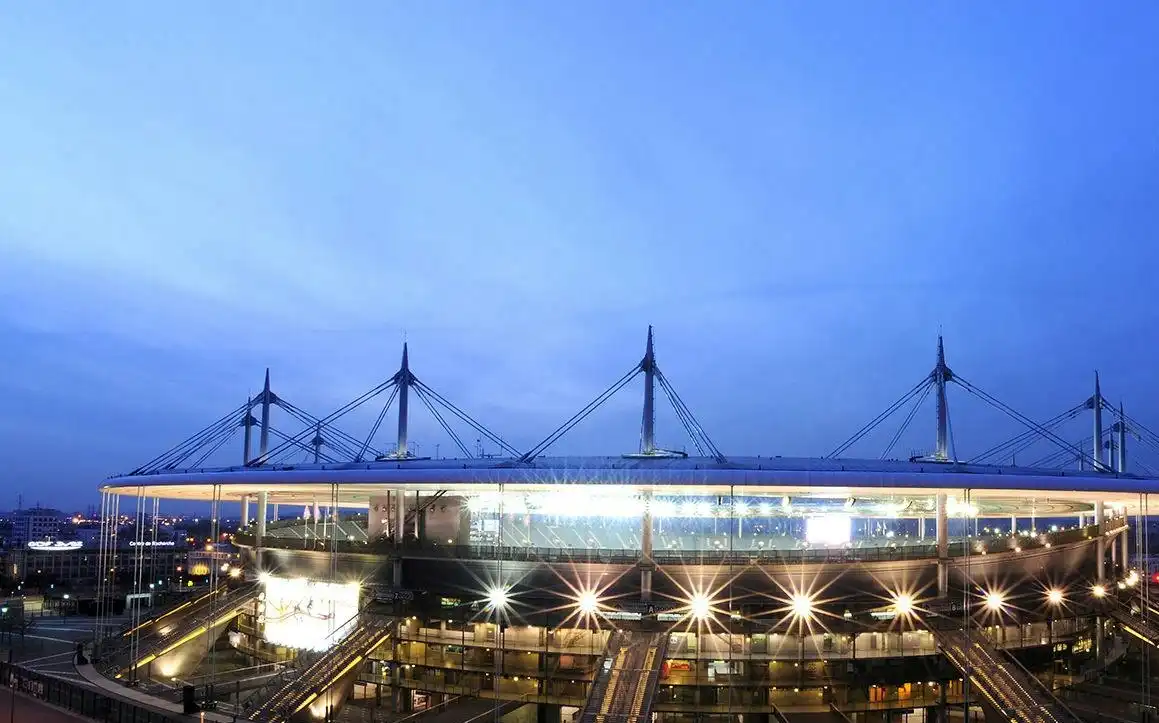
The Stade de France, situated in the vibrant commune of Saint-Denis just north of Paris, stands as a monumental pillar of contemporary French history. Inaugurated in 1998 by President Jacques Chirac, it was purpose-built to serve as the crown jewel for the 1998 FIFA World Cup. Its historical legacy was sealed almost immediately when the French national team, led by Zinedine Zidane, secured a legendary 3-0 victory over Brazil on its pitch, sparking a wave of national unity. Since that "mythic" night, the stadium has evolved into a "temple of sport," hosting prestigious global events including the Rugby World Cup, the UEFA European Championship, and the Paris 2024 Olympic and Paralympic Games.
The stadium is a masterpiece of visionary architecture, designed by the collaborative team of Macary, Zublena, Regembal, and Costantini. Its most striking feature is the six-hectare floating roof, a translucent technical feat that appears suspended above the stands, protecting spectators while allowing natural light to illuminate the grass. As the world’s largest modular stadium, it utilizes a sophisticated retractable seating system that can uncover an athletics track, adjusting its capacity to over 80,000 seats. This logistical ingenuity ensures that whether it is hosting a high-stakes football match or an XXL concert by global icons like the Rolling Stones or Beyoncé, the venue remains perfectly adapted to the performance.
Visitors to the Stade de France encounter an atmosphere charged with "raw energy" and collective emotion. Beyond the grandstands, the stadium offers a unique immersion into the world of elite sports through guided tours of normally inaccessible areas. One can walk through the players' tunnel, explore the locker rooms where legends prepared for battle, and visit the presidential boxes. The experience is further enriched by the celebrity promenade on the Stade de France Boulevard, featuring the handprints of stars like Usain Bolt and Muse. This "village within a stadium" is not just a sports venue but a symbol of the rebirth of the Plaine Saint-Denis, bridging the gap between Paris's historic past and its dynamic, modern future.
Highlights
- The Stadium Bowl stands as a monumental architectural masterpiece and the prestigious heart of French sporting history.
- Experience the thrill of the Players' Tunnel as you walk onto the pitch where legendary victories were secured.
- Discover the inner sanctum of the Locker Rooms, still imbued with the emotion of the 1998 World Cup champions.
- The Translucent Floating Roof is a visionary technical feat that spans six hectares above the stands.
- Visit the exclusive Presidential Box for a breathtaking view of the entire arena usually reserved for VIP guests.
- Explore the Stade de France Museum to see historic objects, photos, and models that showcase the stadium's legendary events.
- Walk along the Stadefrance Boulevard to see stars immortalizing the passage of world-renowned athletes and artists.
Must-Dos
- Gaze at the Saint-Denis skyline from the upper terraces to spot the historic Basilica of Saint-Denis through the gaps in the stadium structure.
- Stand in the press conference room to experience the bright lights and high-pressure atmosphere where coaches and players address the global media.
- Investigate the retractable stand mechanics at the lowest levels to understand the engineering that allows thousands of seats to slide back for athletic events.
- Capture a photo of the monumental exterior pillars that form the imposing structural skeleton of this massive sporting landmark.
- Walk across the broad esplanade that encircles the stadium to feel the immense scale of the sixteen distinct access ramps.
Guidelines
- All guests must undergo metal detector screening and bag searches before entering the stadium to ensure the security of all events.
- Visitors are encouraged to limit the number of personal items brought into the venue to expedite the mandatory security checks.
- The venue prohibits outside food and drink, with the exception of empty water bottles.
- Dangerous items such as alcohol, drugs, fireworks, and explosives are strictly forbidden on the premises.
- Prohibited items include guns, knives, and tasers, as well as any other objects deemed a potential safety hazard by security.
- Laser pointers, air horns, and noisemakers are not allowed inside the arena to avoid disrupting the event.
- Recording equipment including video cameras, audio recorders, and cameras with detachable lenses are restricted from the facility.
Tips
- Plan to arrive at least 90 minutes to 2 hours before your event begins to comfortably clear security checkpoints and find your seat.
- If your ticket is for Porte X through Porte C, take the RER B to La Plaine Stade de France to minimize your walking distance.
- Avoid sitting on the east side of the stadium during summer evening events to ensure the setting sun isn't in your eyes for half the show.
- Purchase your return transport tickets in advance or via the Bonjour RATP app to avoid long queues at ticket machines after the event.
- You can bring a 50 cl plastic bottle without a cap into the venue to stay hydrated and save money on concessions.
- Visit the Stade de France Museum before your scheduled guided tour, as entry is included in your ticket price.
- If you are looking for pre-event drinks, check out the bars and restaurants along Av. Jules Rimet where the atmosphere is lively and communal.
Why Visit
Stepping into the Stade de France is a transformative journey that takes you far beyond the typical tourist path, offering a visceral connection to the very soul of modern France. While the city’s historic center dazzles with its classical charm, this monolithic arena represents the bold, beating heart of the nation’s contemporary identity. To visit is to stand at the crossroads of world-class engineering and legendary achievement, where the sheer architectural scale of the esplanade and the towering exterior pillars command a sense of awe that few buildings on earth can replicate. It is a rare opportunity to transition from a mere spectator to an insider, gaining access to the high-stakes press conference room and witnessing the mechanical genius of the retractable stands that keep this venue at the pinnacle of global versatility.
Beyond the concrete and steel lies an invisible, potent energy—a collective effervescence that lingers long after the final whistle or the last encore. As you ascend the upper terraces, the sensory experience peaks; you are caught between the Saint-Denis skyline and the hallowed turf below, feeling the residual "raw energy" of 80,000 voices that have united here in moments of pure, unadulterated joy. This is not just a stadium tour; it is an immersion into a shared human experience where the air still feels charged with the echoes of triumph and the profound emotional synchrony that defines French national pride.The Stade de France is a monumental sanctuary of collective joy and architectural wonder, standing as an essential pilgrimage for anyone seeking to feel the true, unyielding pulse of modern Parisian spirit.
When to Visit
Mid-Week Morning Corridor Access
Securing a spot on the first guided tour at 10:30 AM on Tuesday or Wednesday provides the most streamlined entry process and the lightest foot traffic within the locker rooms and players' tunnel. Avoiding the heavy weekend tourist influx allows you to clear the mandatory metal detector and bag screenings significantly faster, often reducing the typical wait by 30 to 45 minutes. Steer clear of booking any visits during the two days prior to a match or major concert, as setup logistics frequently lead to restricted area closures and increased staff activity that can disrupt the tour flow.
Twilight Glow Across the Arena Bowl
Aiming for the final tour slot at 4:00 PM during the winter months or late afternoon in summer captures the most dramatic visual transition as the sun begins to dip below the stadium's distinctive elliptical roof. This timing allows you to witness the shift from natural daylight to the activation of the monumental floodlights, which cast long, cinematic shadows across the emerald pitch and seating tiers. Position yourself on the upper terraces during these closing moments to see the sky turn a deep indigo, providing a sharp architectural contrast against the illuminated Saint-Denis skyline and the distant Basilica.
How to Visit
Getting the most out of your visit to the Stade de France requires a bit of logistical savvy, as this 80,000-seat titan operates with the precision of a Swiss watch. To fully appreciate the scale and the "backstage" secrets, you should budget at least 1.5 to 2 hours. This gives you ample time for the mandatory security screenings and a relaxed stroll through the museum before your guided session begins.
Finding Your Way to the Starting Line
The most important tip for a stress-free start is to head directly to Porte H. This is the designated meeting point for all guided tours and where you'll find the official shop and museum entrance. Since the stadium is located in Saint-Denis, public transport is your best friend; the RER B (La Plaine Stade de France) or RER D (Stade de France - Saint-Denis) will drop you within a short walk of the gates. Arriving 30 minutes early is essential, not just for the security check, but to browse the museum’s collection of jerseys and memorabilia which sets the stage for the tour.
The Champion's Circuit
Once your guide leads you past the public barriers, you'll follow a route designed to mirror the journey of a world-class athlete. The path is carefully choreographed to show you the functional heart of the arena:
- Start in the Presidential Boxes to get a bird's-eye view of the pitch and understand the sheer engineering feat of the floating roof.
- Descend into the private world of the Locker Rooms, where you can see where legends prepare for the world's biggest matches.
- Walk the famous Players' Tunnel, a narrow, high-anticipation corridor that leads directly to the edge of the pitch.
- Finish your journey in the Press Conference Room, where the post-game drama unfolds under the bright lights of the global media.
Schedules
Opening Hours
- The Stade de France offers guided tours daily starting at 10:30 AM, 11:00 AM, 2:00 PM, or 4:00 PM depending on the season and language.
- Visitors are required to arrive at the stadium at least 30 minutes before their scheduled tour departure for mandatory security checks.
- Guided tours typically last approximately 90 minutes, and the venue is closed to visitors on the days of major events and certain public holidays.
Special Days
The venue is exceptionally closed on January 1st, May 1st, and December 25th.
Tours are canceled or restricted on the eves and days of major events, so checking the official calendar is essential.
Guided visits remain available on several public holidays, including Easter Monday, Bastille Day, and Armistice Day, provided no matches are scheduled.
How to get there
Situated in the vibrant commune of Saint-Denis just north of the Parisian city limits, the Stade de France stands as a monumental landmark easily reachable through the capital's comprehensive transit network. This architectural masterpiece is exceptionally well-served by high-capacity rail lines, ensuring a seamless journey for spectators traveling from the heart of Paris or its international airports.
- RER B: Take this line toward Aéroport Charles de Gaulle or Mitry-Claye and alight at La Plaine Stade de France, which is approximately a 10-minute walk from the stadium.
- RER D: Travel toward Creil and exit at the Stade de France - St Denis station, followed by a 10-to-15-minute walk to the gates.
- Metro Line 13: Take the train toward Saint-Denis Université and get off at St Denis - Porte de Paris, the closest metro stop located just a short walk from the arena's northern entrance.
- Metro Line 14: Ride to the St Denis - Pleyel terminus for a modern transit alternative, reaching the stadium in about 20 minutes on foot.
- Metro Line 12: Alight at the Aubervilliers - Saint-Denis Front Populaire station for a roughly 25-minute walk to the venue's southern side.
- Tramway: Use Line T1 to the St Denis Basilique stop or Line T8 to St Denis - Porte de Paris for convenient local access within the Saint-Denis district.
- Bus: Multiple lines serve the area, including Lines 139, 153, 173, 255, and 350, providing various points of entry around the stadium perimeter.